Showing posts with label Hat Badge. Show all posts

Thursday, June 1, 2017

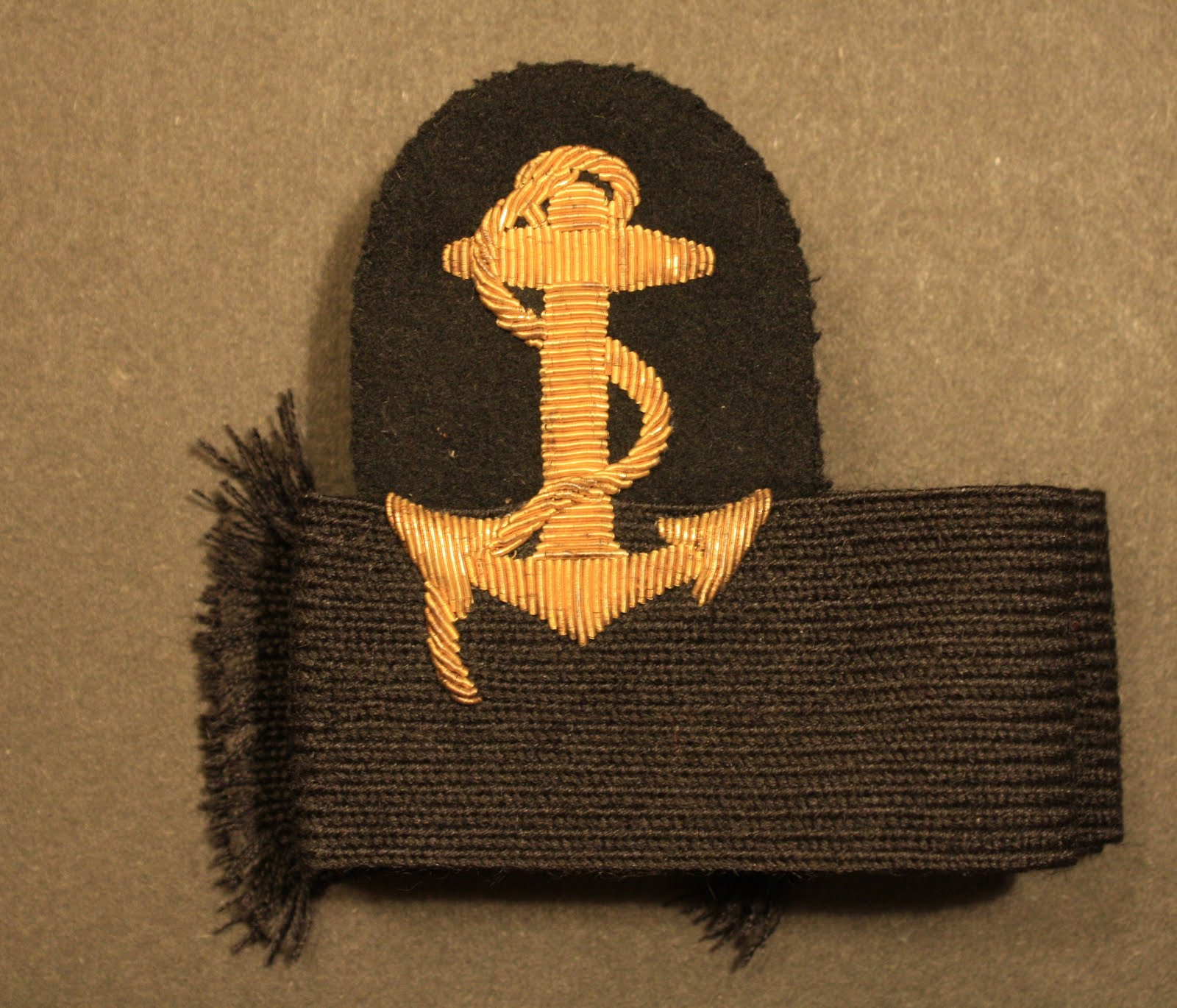
U.S. Navy V-7 program insignia at Columbia and Ft. Schuyler

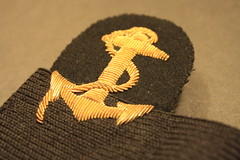
U.S. Navy V-7 midshipman hat badge.
Single piece construction.
Fouled anchor; gold-filled.
Late Second World War era.


Almost twenty years ago I read Herman Wouk’s 1951 Pulitzer Prize winning novel, The Caine Mutiny.  Recalling Captain Queeg, ball bearings, and strawberries, I recently decided to re-read the novel.  The work fashions a re-creation of the culture of urgency that both defined and circumscribed midshipman life during Second World War.  It accomplishes this by detailing the career of U.S. Navy midshipman at Columbia University.  Soon after completing this reading, I learned that Wouk not only took part in the V-7 midshipman program but he both attended and graduated from the U.S. Naval Reserve Midshipmen’s School at Columbia University.

Following this lead, I consulted a series of the program’s yearbooks – The Sideboy – and found Wouk in the August 1942 class.  His company barracked at Furnald Hall, as did the protagonist of The Caine Mutiny: Willie Keith.  Wouk’s descriptions of the place and the program match both Columbia and the photos in The Sideboy.  Thus, despite his novel being a work of historical fiction, it offers a rare insight and serves as a good primary source as to the functions of a little-studied midshipman organization.

The V-7 program was one of four Reserve officer-intake programs inaugurated by the U.S. Navy in February 1942 (V-1, V-5, V-7, and V-12). V-7 was one in which recent college graduates  or men about to complete their college training, were accepted by the U.S. Navy as apprentice seamen and sent to one of the seven Reserve Midshipmen’s Schools:  Columbia, Cornell, Naval Academy at Annapolis, Northwestern, Notre Dame, Plattsburg, and Fort Schuyler.  At the program’s outset, candidates served an initial month as seamen followed by four as an appointed midshipmen; by war’s end, this was compressed to three. After this period of intense naval indoctrination, they were granted commissions as ensigns and went directly to the Fleet or to one of the numerous special advanced schools for final training; e.g. Wouk attended one of such at Harvard for Communications.  Of his sojourn at the Midshipmen’s school and time with the Fleet, Wouk admitted that it figured as a major part of his education: “I learned about machinery, I learned how men behaved under pressure, and I learned about Americans.”

At Columbia University there is a plaque commemorating the Midshipmen’s School, which operated on its campus during the Second World War. It was presented to the University at the cessation of school’s activities.  It may be viewed on the south side of campus at Butler Library and is located on the east balustrade of the short staircase approaching Butler Library, just below waist level.  It reads:

To Columbia University
In appreciation of its generous assistance
and unceasing cooperation in the training
of 23,000 officers who went from the
U.S. Naval Reserve Midshipmen’s School
New York
to Active Duty in World War II
to defend the principals which this
University has always upheld

Commodore John K. Richards, U.S. Navy
Commanding Officer
April 20, 1942 November 2, 1945

Seal of U.S. Naval Reserve Midshipmen’s School

The U.S. Navy eventually used twelve Columbia buildings, including Furnald and John Jay Halls, to house the Midshipmen’s school; classes were held on Columbia’s Morningside campus and in a ship docked at Riverside and West 136th Street on the Hudson River.  At one point, Columbia University’s USNR Midshipmen’s School rivaled the United States Naval Academy in size.  In all, it trained more than 20,000 officers; most of whom served in the Pacific Theatre of Operations.

The following narrative of the Columbia USNR Midshipmen’s School is based upon two consecutive classes; the 7th of August 1942 and 8th of October 1942.  Within that 3 month period, vast changes occurred in the fabric of the program.

Program candidates began their initial training at Notre Dame in April 1942. After two weeks of apprenticeship training, they traveled to Columbia for a continuation of their indoctrination.  They were divided into two groups:  Engineering and Deck.  By graduation from the program, only 429 of the 500 of the former remained, and 284 of 350 of the latter. The instructional staff guiding the training of the midshipmen was divided into the following departments:

Administration
Drill
Navigation
Seamanship
Ordnance
Construction and Main Engines
Boilers and Auxiliaries
Deck for Engineering
Engineering for Deck
Medical Corps
Supply

Some senior officers were regular Navy. However, the majority of the staff were young USNR ensigns assisted by Chief Petty Officers and a few Warrant Officers.

Following the model as set at Annapolis, USNR Midshipmen followed a regimental and battalion structure.  There were two battalions; the 1st at the USS Prairie State (a barracks ship known as “The Ark” or “Black Hole of Calcutta”) and the 2nd at Furnald Hall (the USS Funald, the only ship with 10 decks – the lower deck was on top and vice versa).  Each Battalion was comprised of four and three companies, respectively.  Midshipmen stood watch, served in “black gangs,” drilled, and attended class from morning until night for each day of the week – unless granted weekend liberty or attending divine worship services.

The Regimental staff was comprised of a Staff and Color Guard component. The noted stripe count represents the number of stripes on the midshipman's sleeve*:

Regimental Staff
Commander 
– 4 stripes
Adjutant – 3 stripes
Signalman – 2 stripes
Regimental Chief Petty Officer 
– 1 stripe
Bugler – 1 stripe

Regimental Color Guard**
National Colors
Regimental Colors
Color Guard (2 midshipmen)

Battalions and Companies and had their own respective staffs that reported up the chain of command:

Battalion Staff
Commander 
– 4 stripes
Adjutant – 3 stripes
Signalman – 2 stripes
Battalion Chief Petty Officer – 1 stripe

Company Staff
Commander – 3 stripes
Sub-Commander – 2 stripes
1st Platoon Commander – 1 stripe
2nd Platoon Commander – 1 stripe
Battalion Chief Petty Officer – no stripes

* relative rank vis Annapolis as noted by stripe count:

4 stripes – Midshipman Lt. Commander
3 stripes – Midshipman Lieutenant
2 stripes – Midshipman Lieutenant Junior Grade
1 stripe 
– Midshipman Ensign

** no stripes
Company strengths by August 1945, were as follows:

1 – 109
2 – 107
3 – 108
4 – 105
5 – 97
6 – 93
7 – 94

In August 1942, V-7 midshipmen at Columbia wore uniforms almost exactly like those of their counterparts at Annapolis, with some distinct changes. Since theirs was a four-month program with the classes compressed and joining year-round, their “plebe” period saw midshipmen wearing the appropriate uniform for the season. For instance, the October 1942 class started out wearing US Navy enlisted undress blues for their initial period at Notre Dame, then switched to the familiar usual plebe whites. These were USN enlisted undress white jumpers with stenciled U.S.N.R. at mid-chest on the blouse; the midshipmen-to-be were not issued black silk scarfs. Both uniforms shared the blue-rimmed white hat – at the time called a Bob Evans hat, and now colloquially called a Dixie-cup hat. Those apprentices holding a Company and above leadership, position wore a white covered combination hat, and not the white hat with their undress whites or blues.

Those passing basic indoctrination period – not being “bilged” – rated full USNR Midshipman status.  They, in turn, gained the privilege of donning the six-button midshipman reefer, with the classic midshipman gold anchors on the upper coat collars. On the right cuff, they wore a three-prop propeller for Engineering or clean-sleeve for Deck as program marker. There were no “class” indicators of the vertical gold stripes on the coat sleeve like those at Annapolis; however, regimental officers wore horizontal rank stripes on both sleeves (with program indicator above, no stars). There were four, three, two, and one stripers as indicated above. Midshipmen petty officers and buglers, during this period, did not have crows and chevron, nor bugle patches.

Depending upon the program, midshipmen wore dungarees, undress whites and blues (crackerjacks without tape or silk ties), khakis, and dress blues. Both programs wore dungarees were worn in machine spaces; Engineering midshipmen wore undress blues or whites depending on season in classrooms; and Deck midshipman wore undress khakis (without jackets) in classrooms.  For Friday drill and inspection, all midshipmen wore service dress blues and combination hats with white covers. Regarding the khaki uniforms, midshipmen wore combination hats with khaki covers with a 1/8in-width gold chinstrap and on both collars, wore anchor devices on both collars. The anchor shank was horizontal in relation to the top of the wearer’s collar, with flukes inboard toward the neck, and stock outboard.

Fort Schuyler, the present site of the State University of New York Maritime School and once the New York Nautical School, has no plaques or commemorative markers of the shared grounds of the V-7 school nor of the brief sojourn of the U.S. Merchant Marine Cadet Corps in its midst.  The Midshipmen’s School was wedged between the Fort and the present gatehouse.  It shared wooden frame barracks and facilities with a Navy advanced school.
By comparison, at war’s end, Fort Schuyler's V-7 program yearbook
Gangway (published in October 1945) shows an altogether different organization of USNR Midshipmen.  Their program was also for a period of four months.  Images and texts suggest a need for expediency.  Teaching methods and means of turning out newly minted Naval Officers was honed to a science; anything not tantamount to the ultimate purpose of producing officers was cut. 

In uniform matters, from the laconic description of the program and presentation of collective memories, there is no indication of a plebe period where program inductees wore jumpers and Dixie-cup hats. These Atlantic Coast midshipmen wore working grays and were provided with service dress blues. They were not issued khaki uniforms. On their garrison hats was the midshipman anchor. They wore sets of horizontal midshipmen class anchors on their shirt collars. The service dress blues was the classic six-button USN officer uniform – except the coat collar had the midshipman anchor like those found on period Annapolis midshipman hats. These anchors were mirror images of each other, and are pin-back, and not with cap-screws (tabs). I see no indication of midshipman leadership positions; this program appears to be more of a boot-camp style organization. Midshipmen lacked chevrons, hashes, and shoulder boards on all uniforms – including the grays.

References
Herman Wouk. The Caine Mutiny. New York, Back Bay Books, 1992.

Leon Rogow (foreword). The Sideboy August 1942. New York, NY U.S. Naval Reserve, 1942.


Late war V-7 hat badge. 10K G.F. (Gold-Filled). Note: It is of the same design and size as the coat collar anchors.


Early V-7 coat anchor, 10K G.F. (Gold-Filled), H-H.


Late war V-7 coat anchor pair, 10K G.F. (Gold-Filled).


Late War V-7 collar anchor pair, 10K. It looks like they've been polished down to brass, as they've not the luster of the other insignia.

Saturday, January 14, 2012

Robin Line

Robin Line ship officer hat badge.
Three piece construction.
Eagle and shield sterling; wreath brass/gold-plate. Company insigne brass and enamel. Late Second World War era.
badge: 60mm x 65mm

On the second page of the March 17, 1954 edition of the Wilton Connecticut Bulletin there is long column about a GOP Sunday Tea. The Bulletin reports that the tea was a breezy affair attended by the community's upper crust; although not mentioned was the striking absence of Arthur Lewis, Jr. This would be explained by a single line next to the column reading: "Arthur Lewis Dies", followed by  a pithy obit - speaking nothing about his frantic life nor his high-paced career or even funeral arrangements.  Perhaps the same-page announcement of solo-trumpeter Roland Kutik indicated him more a town favorite than the two decade cut-throat steamship executive.

On his first vacation in years, Arthur R. Lewis, Jr. died of a heart attack in sunny Fort Lauderdale. He was the workaholic president of Seas Shipping Company, whose main and best-known subsidiary was the Robin Line. Lewis' professional life was driven by his twin obsessions: profits and desire to crush his firm's competition - the Farrell Line. The Robin Line and Farrell Line rivalry was one of the most vicious and vindictive rate wars in United States maritime history. This is striking in that the Lewis and Farrell families once shared a close personal and business relationship; in fact the Robin Line was established in 1920 by his father, Arthur R. Lewis, Sr. in concert with the Farrell family. Robin Line ships operated in the intercoastal trade as auxiliaries to various Farrell concerns; mainly the Isthmian Steamship Company - the US Steel shipping company - and the American South African Line - in which Lewis, Sr. had partial ownership. However for reasons not public and perhaps secreted away in the exclusive India House, this immediate and irreconcilable rift between the families resulted in the 1933 separation of ownership and management of all shared firms. The Farrells ended up with full control of the American South African Line and the Argonaut Line; the Lewises gained the Sea Shipping Company and its Robin Line.

Soon afer the division of interests, Lewis, Sr. died and his son took up his mantle with gusto. Lewis, Jr. continued to operate the Robin Line's four ships in the intercoastal trade and did not foray into international shipping. Relations between the families remained combative, and the opportunity for Lewis to strike a blow against the Farrells presented itself in the person of Sylvester J. Maddock. Maddock, an employee fired by the Farrells, convinced Lewis to bring the Robin Line into the African trade in 1935. As general agent, Maddock knew the ports and shippers in Africa and thus was able to build up the cargo volumes for the Robin Line at the expense of the American South African Line.

When the United States Shipping Board established direct service between the United States and South Africa, British lines - which prior operated a triangular service via the British Isles and other regions - decided to mimic the American model to diminish the upstart competition in a once sole British preserve. In order to avoid destructive competition between each other and to stave off British ascendancy, the American lines involved in the trade, following the same framework for other regional conferences and agreed in 1924 to establish the U.S.A.-South Africa Conference. The Conference set rates, routes and number of sailings for its members. This was an outward conference with jurisdiction only over cargoes leaving the United States; the lines created a separate complimentary body - the South Africa-U.S.A. Conference - with jurisdiction over the inbound cargoes coming from South Africa to the United States. Although South Africa was the center of the trade, the conference, in spite of its title, held an undefined jurisdiction for decades over the east and west coasts of Africa, as far north as the Azores and the Canary Islands on the west coast of Africa and up to Tanzania on the east. When the Robin Line applied for membership in the conference in 1935, James A. Farrell, Jr., blocked the application, thus initiating a bitter rate war. To try to drive the Robin Line from the trade, the Farrells orchestrated the U.S.A.-South Africa Conference to reduce its rates from twenty dollars to eight dollars a ton, and eventually to four dollars; this last figure barely covered half of operating costs, and as a result both companies including the other conference members were taking heavy losses on each voyage. The Robin Line did not collapse, however, because it was shipping large volumes of automobiles to South Africa for Chrysler and Ford. When the Robin Line bid for membership in the Conference again as a way of ending the rate war in 1936, the Farrell family once again had the application rejected. The Farrels felt confident in the liquidity of the American South African Line since it had the advantage of a generous US mail contract under the provisions of the Merchant Marine Act of 1928 to keep it afloat; yet despite the lack of such a contract, the Robin Line managed to survive. The rate war continued until 1937, when a reduction in the government subsidy at last forced the Farrell family to call it off; but losses had been so great that the American South African Line was on the verge of bankruptcy and saved only by profits garnered from other Farrell shipping interests in the Atlantic trade.

In 1938 the Robin Line managed to secure its own subsidy from the U.S. Maritime Commission, and the next year the Second World War with its high shipping rates temporarily served to halt the destructive competition. At the same time the Robin Line gained entrance into the much-coveted conference.  Flush with cash and subsidies, the Robin Line acquired several new ships for the first time in almost a decade.  These new ships were streamlined and were dubbed the "best-looking" freighters on the oceans by mariners at the time. With the ubiquitous automobile, farm and road-building equipment cargoes inbound, the Robin Line carried rock lobsters (crayfish), exotic timber, gold bullion and freight-neutral diamond cargoes outbound. These new ships were known for their extensive refrigeration plants for the former and welded-shut safe compartments for the latter, and smart crew accommodations.

Although the two lines remained rivals, they preferred to respect the agreements of the U.S.A.-South Africa Conference. During the Second World War, the vessels of both lines were requisitioned, and both operated government ships for the War Shipping Administration under ships husband agreements. After the return of peace, the two lines resumed their bitter rivalry. In hearings before the U.S. Maritime Commission, the Robin Line, because of the opposition from the Farrell Line, lost the subsidies on the route from U.S. Atlantic ports to West Africa in 1947. However, when Farrell declined to handle the unusually large volume of automobile exports to South Africa, the Robin Line - who previously provided the service and won lasting goodwill among the automobile exporters - took up the slack to its benefit. In 1955 the last of the British lines withdrew from the route, leaving as active conference members only the Robin and Farrell Lines (American South African Lines renamed) in the region.

With Lewis, Jr.'s death none of the family members wished to follow his breakneck work ethic, instead they elected Winthrop O. Cook as Seas Shipping Company new president. As president, Cook found before him the expensive task of replacing the company's old wartime surplus vessels. Instead of investing in a costly and immediately unprofitable project, Lewis' heirs decided to avoid the problem altogether and sold the Robin Line to Moore-McCormack in March 1957; making a tidy profit, as seen in the transaction records as argued before United States Court of Appeals Second Circuit (371 F.2d 528): "Seas Shipping Company, Inc., sold ten ships to Moore-McCormack Lines, Inc. [...] for $5,466,668 in cash and notes and 300,000 shares of Mooremac stock." Soon thereafter, the new owner removed the vessels of the former Robin Line from the African trade, leaving only the Farrell Line in the U.S.A.-South Africa Conference.

House Flags of Robin Line
  • Blue with a white lozenge bearing a red R. 1920-1942.
  • Blue with a white oval in the hoist, with a stylized wing with three sections sweeping toward the fly; oval contains red R. 1942-1957.
Ships of Robin Line
It is worth noting that the Robin Line was so called because all its ship names began with the word "Robin".

Pre-War

Robin Adair (built at close of the Great War by Skinner & Eddy Shipyard, Seattle)
Robin Doncaster
Robin Goodfellow
Robin Gray

Second World War (1942-1948)

Robin Adair
Robin Doncaster
Robin Goodfellow
Robin Gray
Robin Locksley
Robin Sherwood
Robin Tuxford
Robin Wentley
Post-War (1948-1955)
Robin Doncaster
Robin Goodfellow
Robin Gray
Robin Hood
Robin Kettering
Robin Kirk
Robin Locksley
Robin Mowbray
Robin Sherwood
Robin Trent
Robin Tuxford
Robin Wentley

1955-1957

Robin Doncaster
Robin Gray
Robin Hood
Robin Kettering
Robin Kirk
Robin Locksley
Robin Sherwood
Robin Trent
Robin Tuxford
Robin Wenley

Moore-McCormack purchase (1957)

Robin Gray
Robin Hood
Robin Kirk
Robin Locksley
Robin Mowbray
Robin Sherwood
Robin Trent

Principal Executives
Arthur R. Lewis, Sr.: 1920-1933
Arthur R. Lewis, Jr.: 1934-1954
Winthrop O. Cook: 1954-1957

References
The Decisions volumes are particularly interesting as they document legislative activities around and Robin Lines gripes with the U.S.A.-South Africa Conference; relevant entries may be found under Seas Shipping Company.  Interestingly, the Maritime Commission and its successor Federal Maritime Board did not lend a kind ear to Lewis. Albion's monograph is interesting in that it is an economic history of the South Africa trade with a focus on the Farrell Line; it presents the family in a positive light and takes an apologetic approach to its foreign-flag activities, anti-union stance and ignores overall poor crew conditions; Lewis and the rate war is mentioned practically in passing.

"Arthur Lewis Dies." Bulletin, Wilton Connecticut. March 17, 1954: p 2.

Obituary. New York Times, March 17, 1954.

Federal Maritime Board. Decisions, Vol. 4, 1952-1956. Washington, D.C.: Government Printing Office, 1963.

U.S. Maritime Commission. Decisions, Vol. 3, 1947-1952. Washington, DC: Government Printing Office, 1963.

War Shipping Administration. United States Maritime Service Training Manual, Deck Branch Training. Washington, D.C.: Maritime Service, 1943. p. 45.

Robert G. Albion. Seaports South of Sahara: The Achievements of an American Steamship Service. New York: Appleton-Century Crofts, 1959.

Rene De La Pedraja.  A Historical Dictionary of the U.S. Merchant Marine and Shipping Industry: Since the Introduction of Steam.  New York:  Greenwood, 1994.

Colin Stewart. Flags, Funnels and Hull Colours. London: Adlard Coles Ltd., 1957.

Captain Frederick James Newdigate Wedge. Brown's Flags and Funnels of British and Foreign Steamship Companies, 5th Edition. Glasgow: Brown, Son & Ferguson, 1951.

United States Court of Appeals Second Circuit. 371 F.2d 528: Seas Shipping Company, Inc., Petitioner, v. Commissioner of Internal Revenue, Respondent. Argued December 1, 1966 Decided January 16, 1967.

Many kind thanks to Captain Jack Misner for sharing his recollections of his time with the Robin Line.


Robin Line, Hat badge, obverse
Eagle and shield sterling; wreath brass/gold-plate. Company insigne brass and enamel.
Second World War era.
Mounted on wool backing and mohair band.
badge: 60mm x 65mm

This badge uses the US Maritime Service officer hat badge as a base and has the the anchor device replaced with a company insigne. As mentioned in previous posts, this was a common practice followed during the Second World War by ship officers throughout industry. This particular badge is interesting is that it does not use the company house flag on the the badge, rather a bow design element. Some Robin Line ships used the Blue-White-Red wings flanking the R in oval device on the bow; the slight incline of the R denotes speed, which the Line was famous for.

Do note the high degree of corrosion on exposed copper/brass elements and chipped enamel.
The insigne is without or has a corrosion obscured hallmark. I am unable to remove the the badge from backing to determine any hallmarks on the other component elements; the top keeper nut is welded in place by corrosion.


Robin Line, Hat badge, obverse detail


Robin Line, Hat badge, backing and mohair band detail


Robin Line, coat lapel badge
No hallmark. Gold-plate brass. Second World War era.

This badge would be found in pairs on either coat lapel of a ship officer's reefer. This badge is gold-plated brass, with most of the gold rubbed away. Although the badge itself is without a readable hallmark, the pin snap has a miniscule H&H (Hilborn & Hamburg) star hallmark on its face and is marked Sterling.


Friday, October 28, 2011

British Tanker Co.

British Tanker Co.
Officer hat badge
Metal, gold wire, silk and colored thread on wool backing.
Circa 1940s.


Lately there has been an increased number of television commercials urging tourists to flock to vacations on the Gulf Coast - all of which are sponsored by British Petroleum. This brings to mind that last year I presented a British Petroleum Shipping Co. Officer hat badge, here. In that post I mentioned an earlier hat badge used between 1926 and 1955; presented now is said badge.

The period in which this hat badge was worn was an exciting one for the Anglo-Persian Oil Company, and by extension British Tanker Co. - profits were terrific, ships were built, the War came and Persia became Iran. There was much expansion of British oil exploration throughout the Middle East, and the Kingdom of Persia in particular. With government backing, the tanker fleet became one of the largest in the world, and its ships could be seen plying the waters between the Persian Gulf and the Suez on up to the British Isles - with regular stop-overs at the Port of Aden, where British interests created a safe haven for its sailors in the protectorate. In an effort to have a more efficient and profitable tanker fleet, vessels were fitted with modern tanks, pumping systems and numeous safety measures. The Second World War came, and with the declaration of hostilities, British Tanker Co. found its fleet under attack; by war's end, a third of its assets sunk and later replaced. By 1955, the British Merchantile Marine reached its zenith, and afterward met an eventual swift decline. BP survived, the fall, however.

References:
Over this past year, I have come across many excellent and encyclopedic works on general British Petroleum history, with scant passages on its tanker fleet throughout. Bill Harvey's book remains the best reference for BP tankers, in specific.

Bill Harvey, BP Tankers: A Group Fleet History. London: Greenhill Books, 2006.

Henry Longhurst, Adventure in Oil: The Story of British Petroleum. London: Sidgwick and Jackson, 1959.

Ronald W. Ferrier, The History of the British Petroleum Company, Vol. 1: The Developing Years, 1901-1932. London: Cambridge University Press, 1982.

James H. Bamberg, The History of the British Petroleum Company, Vol. 2: The Anglo-Iranian Years, 1928-1954. London: Cambridge University Press, 1994.

James H. Bamberg, The History of British Petroleum, Vol. 3: The Challenge of Nationalism, 1950-1975. London: Cambridge University Press, 2000.


British Tanker Co., officer hat badge, obverse
Metal, gold wire and colored thread on wool backing.
Circa 1940s.

The central badge device is comprised of a rectangular British Tanker Co. house flag of applied ribbed silk fabric - with details stitched in silk floss - and outlined with coiled gold metal. The flag is surrounded by laurel leaves of gold purl with stems of applied coiled gold metal. Surmouting all is a stamped gilt base metal lion passant gardant. All is stitched on a padded black wool base.


British Tanker Co., officer hat badge, obverse detail


British Tanker Co., officer hat badge, obverse detail


British Tanker Co. Ltd.
House Flag.
838.2 x 1219.2 mm
National Maritime Museum, Greenwich, London, Pope Collection.

The house flag of the British Tanker Co. Ltd, London. On a white filed is a red cross with a green diamond in the center bearing a gold lion passant gardant. This design was in use from 1926 to 1955 - the central lion symbolizing the Company's Iranian interests. The flag is made of a wool and synthetic fiber bunting; it has a cotton hoist and is machine sewn. The flag's central design is painted. A rope and two Inglefield clips are attached.


British Tanker Co. Ltd.
British Gratitude ship model.
Scale: 1:192
National Maritime Museum, Greenwich, London.

The British Gratitude is depicted the model below in wartime rig with paravanes, light anti-aircraft machine guns, and anti-torpedo net booms and posts. British Gratitude was owned and operated by the British Tanker Company. Built in 1942 by Swan Hunter & Wigham Richardson, it was 470 feet in length and 8463 tons gross, very small by contemporary standards. It survived the Second World War and continued to have an active career under the ownership of British Petroleum. She was eventually sold for breaking up in 1959.


From the Collection of Lyle Halkett I present two interesting British Petroleum hat badges.

The first is a modern pattern of the first British Tanker Company design, followed by that of a 1940's pattern of a BTC Petty Officer hat badge; both follow the same symbolic and stylistic language as other presented BP badges. Do take particular note of the Petty officer badge, as it follows the precedent set in The Mercantile Marine (Uniform) Order, 1921 Schedule which states that a Petty Officer's cap badge is to be of the same design as hat of a officer's with the exception that the surrounding oak leaves and acorns be deleted. The schedule outlines a previously announced, but not defined uniform order from 1919.

British Tanker Co., officer hat badge, obverse
Metal, gold wire and colored thread on wool backing.
Pattern circa 1940s.
Collection of Lyle Halkett


British Petroleum Shipping Co. Chief Petty Officer hat badge, obverse.

Metal, gold wire and colored thread on wool backing.
Circa 1940s.
Collection of Lyle Halkett

Monday, June 14, 2010

U.S. Maritime Service Chief Petty Officer

U.S. Maritime Service Chief Petty Office hat badge (1st design, 2nd pattern)
One piece construction.  Seal, 25mm diameter; Anchor, 50mm length.
Obscured AE CO N.Y. hallmark (American Emblem Company).
Anchor and device stamped nickel; blue enamel band and red, white & blue shield.

This is the second pattern of the first design of the USMS CPO hat badge; it was worn from 1939, with the creation of the USMS training program, until  the dissolution of formal Coast Guard management of training program and its transfer to the War Shipping Administration in 1942.  1942 saw a re-design of U.S. Maritime service insignia, and with it, the USMS CPO hat badge.  Both the first pattern of the first design and second design have been respectively treated before, here and here.

This specific badge is often misidentified as a USMS Warrant Officer device; this is an understandable error, as mid-war, individuals who trained at USMS Radio Officer schools were issued USMS CPO hat badges and collar disks, and upon graduation held the appointed rank of Warrant Officer within the U.S. Maritime Service. Compounding some of confusion is that by war's end, USMS Regulations published in 1944 stated that officers in the Radio Department, depending upon vessel tonnage and class, and certificate status could rank anywhere from Lieutenant to Ensign, vid.: U.S. Maritime Service Officers' Handbook, 1944 p5.


USMS CPO Hat badge, obverse.
USMS CPO


USMS CPO Hat badge, obverse detail.


USMS CPO Hat badge, reverse.
Note that the screw post and pins have been sheared off and replaced by a flat pin. It, like its predecessor has the curious "CO N.Y." or "CD N.Y." hallmark.

Sunday, April 18, 2010

U.S. Maritime Service Chief Petty Officer


U.S. Maritime Commission Cadre /
U.S. Maritime Service Chief Petty Office hat badge (1st design, 1st pattern)

One piece construction.  Seal, 25mm diameter; Anchor, 50mm length.
Obscured AE CO N.Y. hallmark (American Emblem Company)
Anchor and device stamped gold-patinated brass; blue enamel band and red, white & blue shield.
Pre-to-early Second World War era; 1938-1939.


This is the first design of the USMS CPO hat badge; it was worn from 1938, with the institution of the USMC, up until the formal creation of the USMS training program in 1939.  The badge itself may be found in plain brass or gold, as well as plated silver or nickel.  The early gold-patinated brass patterns were issued in 1938-1939, followed by plated silver or nickel badges and then a new design came about in 1942.  A description of the second design may be found here.  In practice, in the period leading up to the Second World War, USMS CPOs, more often than not wore the more handsome embroidered hat badges - which were of the same design as the stamped metal device, albeit without the band of stars - as evidenced by an image in the article "Heros of Wartime Science and Mercy" in National Geographic Magazine, December 1943 page 717, as seen here.

Concurrent with WSA control of the USMS, and the stripping away of the ship-building component of the USMS,  came a color and design shift:  for the hat badge: the illustrated deco motif of a stylized Federal "classic shield" gave way to a detailed foul anchor charge on "official shield" of finer detail.  Whereas the first design was predominantly blue, the color changed to red - perhaps to echo the red of chevrons and other woven cloth devices found on an enlistedman's uniform.  My research has alluded to that late in the war, the CPO badge further changed to match the pattern found on USMS buttons (1942-1954); I will post an image of this badge at a later date.

J. Tonelli in Visor Hats of the US Armed Forces incorrectly asserts that the illustrated hat badge was worn by USMS Warrant Officers; however, regulations of the time state that Warrant Officers wear the same devices as regular, commissioned officers.  This is a commonly made mistake when attempting to devise a typology of hat devices for a relatively small organization with a small array of hat insignia.

Overall, the USMS only had a handful of CPOs and these were attached to USMS enrollment offices, training stations, officer schools and the US Merchant Marine Academy; CPO insignia was not issued to regular seamen who were matriculated from or were certified by the USMS. CPOs represented unlicensed seaman hired by the USMS skilled in the maritime industry with some seniority or specialized skills not satisfying the grade of Warrant Officer; it is useful to think of USMS CPOs as experienced Able Seamen (AB).


USMS CPO Hat badge, obverse.
This device was worn by Merchant Mariners attached to the US Maritime Commission involved in training duties; this badge eventually found its way to be only worn by senior unlicensed personnel (CPOs).  This hat badge continued to be issued until stocks were depleted and eventually replaced by a badge of the same design - albeit in nickel (pre- and early war), and then replaced by the more familiar USMS CPO device.  There is some speculation that the USMC/USMS CPO device was modeled after the US Coast Guard enlisted hat badge; however, it is worth remembering that the only badge this specific device resembles is the brass US Coast Guard Shore Installations hat badge - however the USCG badge went into production in 1942, half-decade after the production of the USMC/USMS badge.
The mystery of the design lies in the double-anchor and seal motif.  If analyzed closely, the badge hearkens to the precursor agency of both the US Maritime Commission and US Coast Guard:  the US Revenue Cutter Service.  In this light, the anchor stock and flukes, and as well as the rope on the stock themselves echo the old seal.  At the time of its creation, it was not stated in USMC regulations, but the uniforms and ranks of the soon-to-be-formed USMS were eventually codified to mirror that of the US Coast Guard.  In time, in an effort to create an esprit de corps and the forging of an independent identity, the badge change to the second design.


USMS CPO Hat badge, reverse.


USMS CPO Hat badge, reverse (detail).
Note the curious "CO N.Y." hallmark - the complete "AE CO N.Y." mark is obscured by the post - this is of the American Emblem Company of Utica, New York. This firm produced a number of Merchant Marine and Maritime Service items during the Second World War, most notably the ubiquitous Merchant Mariner pin.  In regard to this specific badge, NS Meyer produced a very similar insignia set for USMS officers using a similar central device. With the button and device change in 1942, AE Co. was no longer contracted to make USMS CPO badges; rather, the jobbing went to Coro.

Wednesday, March 10, 2010

U.S. Merchant Marine Cadet Corps


U.S. Merchant Marine Cadet Corps (pre-1942)
Yellow-goldenrod thread.
Embroidered anchor on wool backing and mohair band.
Pre-to-early Second World War era; 1939-1942.


From the period following the First World War through the Depression, the U.S. Merchant Shipping industry was in a shambles: once profitable companies faltered and fell, ocean-going trade evaporated and even intercoastal shipping dried up. As a result, companies went bankrupt, very few ships were built and crews manning the ships dwindled to a very few. It is also during this period that U.S. maritime unions started operating in full swing, and involved themselves in vicious internecine fighting and bitter struggles with steamship carriers. Of those seamen that survived the wreckage, their efficiency and morale was at an all time low. With the passing of the Merchant Marine Act of 1936, Congress abolished the ineffective U.S. Shipping Board and ushered in a new age for the U.S. Merchant Marine. The formerly under-regulated industry came under federal control and found itself subject to an array of programs and regulations. A few of salient features of the Act were the formulating and subsidizing the construction of U.S.-flag ships, as well as the formal training of men to man the ships.

With the passage of the Merchant Marine Act, the U.S. Maritime Commission came into being. The organization was ostensibly "to further the development and maintenance of an adequate and well balanced American merchant marine, to promote the commerce of the United States, and to aid in the national defense." It too, became embroiled in the old system of unions and steamship carrier falterings. To prop up the maritime industry, the USMC eventually bought out insolvent carriers thereby ringing whole shipping lines under federal control. With the storm clouds of war looming on the horizon, the Merchant Marine Act defined the entirety of the U.S. Merchant Marine as a military auxiliary in the event of war; furthermore, officers and crew of U.S.-flag ships could be pressed into the service of the U.S. Navy.

One of the most sweeping changes made by the act was that the Merchant Marine be "manned with a trained and efficient citizen personnel." The Act did not offer any specifics for the USMC; but soon after, the Bland Amendment of June 1938 created the United States Maritime Service for "training of licensed and unlicensed merchant marine personnel." Shortly thereafter, Congress enacted the Naval Reserve Act bringing all officers of U.S. public vessels into the U.S. Navy reserve as well as cadets (now cadet-midshipmen) at Federally-funded state maritime and the soon-to-be-created Federal system. It is worth mentioning that the U.S. Maritime Commission's first report to Congress in January 1939 suggested the establishment of a federal cadet system augmenting the pool of graduates from state and private schools - moreover along with traditional sea-handling, the system should emphasize naval science. Congress acted quickly and a series of Maritime Service cadet schools opened in the Pacific, Gulf and Atlantic coasts. Navy, Coast Guard and USMS personnel trained the cadets, with licensure remaining in the hands of the Coast Guard. With the declaration of war, the training of the Merchant Marine Cadet Corps was transferred to the Coast Guard in February 1942 and then to the War Shipping Administration in Fall of the same year.

The presented hat badge dates from the period between the founding the the Federal Merchant Marine Corps just prior to the Second World War and the institution of the U.S. Merchant Marine Academy in 1942 through the creation of the U.S. Merchant Marine Academy Cadet Corps Regiment on Dedication Day, November1943. By early 1944, midshipman-cadets began wearing midshipman hat badges mirroring their colleagues at the U.S. Navy Academy in Anapolis.  This hat badge is an embroidered anchor on a wool backing and mohair band; this specific example was removed from a hat and stored over the period of several years. Bands, such as this were an integral part of the hat to which it was affixed, and did not slide off easily as is the case with removable covers and bands of the present-day; hats were spot cleaned or taken to the cleaners. With the United States' formal entry into the war, the U.S. insignia industry servicing maritime and Naval concerns changed its means and modes of production. The older, elegant hat devices made of woven bullion and metallic thread were replaced by metal hat badges and other removable devices; although, those who had means and money continued to purchase and wear embroidered insignia. For cadets, who were rapidly moved through the federal training system, it was more expedient and cost-effective to use stamped metal devices and removable bands. This badge is the last of an era; from this point forward, stamped devices were and continue to be employed.


U.S. Merchant Marine Cadet Corps hat badge (pre-1942), obverse.
Period photographic evidence points to the fact that leading up to the Second World War and in the initial year of the U.S. Merchant Marine Academy's operation, cadet-midshipmen wore embroidered hat badges, rather supplanted by the more common stamped metal (brass, gold plated or gold fill). The presented item may be a custom piece - as the majority of cap devices of the period were comprised of metal thread (bullion) on wool backings - as opposed to silk or composite thread.  It is important to remember that the USMMCC was quite small in the period leading up to the institution of the USMM school system and uniforms were not always that - uniform - young men on the Gulf coast did not always wear the same kit as their colleagues on the West or even the East coast.


U.S. Merchant Marine Cadet Corps hat badge (pre-1942), obverse detail.


U.S. Merchant Marine Cadet Corps, pre-1942 reverse


U.S. Merchant Marine Cadet Corps cadet-midshipman, SUNY Maritime period (1939-1941).


U.S. Merchant Marine Cadet Corps cadet-midshipmen, SUNY Maritime period (1939-1941).
The cadet-midshipmen are shown photographed in working khaki manning a monomy in Long Island Sound. Note that the young gentlemen are not wearing garrison hats, pointing to the fact that this photograph is pre-Regiment. The make of their combination hats is consistent with late-1930s and early Second World War construction. Their uniform shirts lack insignia of any sort, underscoring the same.

Monday, March 8, 2010

U.S. Maritime Service Chief Petty Officer

Maritime Service CPO Hat Badge
U.S. Maritime Service Chief Petty Office hat badge (2nd design)
One piece construction. Seal, 25mm diameter; Anchor, 50mm length.
Coro (Cohn & Rosenberger) hallmark.
Anchor and device stamped brass, sterling plated (marked); red enamel band and shield.
Mid-to-post Second World War era; 1942-1947.

This is the second design of the USMS CPO hat badge; the first was worn from 1938, with the institution of the USMS training program, up until WSA control of the USMS in 1942. The former badge may be found in plain brass or gold, as well as plated silver - as is the case of this badge. The second design is always in silver plate, any other is a pattern or reproduction. The illustrated badge differs from the first with a few stylistic differences - a difference in shield configuration and the inclusion of a motto, and punctured anchor ring. The first employs blue enamel as opposed to red. Interestingly enough, the changed design did not stylistically match that of contemporary uniform coat, cap and shoulder board buttons and snaps which were altered at the same time as the hat badge.

A miniature of this device was authorized and manufactured for wear on overseas caps.


USMS CPO Hat badge, obverse.


USMS CPO Hat badge, reverse.
A close-up of the reverse details the Coro (Cohn & Rosenberger) hallmark as well as the Sterling denotation. Coro, as a corporate name came to be in 1943; however, the incuse hallmark "Coro" with a distinct curly-queue C in serif font dates to 1940 and underwent minor variations until 1945. Moreover, due to wartime metal shortages, Coro produced Sterling insignia items under Government contract from 1942-1947. With the aforementioned in mind, this hallmark adequately dates the device to the early-to-mid 1940s, contemporaneous with USMS insignia change.


USMS CPO Hat badge, production hub.
This hub is composed of hardened steel; of interest are the alignment pins used in the creation of dies. I have already written about production methods specifically outlining the purpose of a hub, here. If you visit the image's page on Flickr, and select "All Sizes", the original size can give you a better idea of the intricacy of design and even the parts of the hub that have been buffed and chiseled.

One reason that dies do not show up often in collections is that as dies wear out, they are taken out of production, defaced and melted down; hubs survive due to the fact that more than one master is required for die production. In terms of USMS hat insignia, hubs are few and far between as there were not a whole lot of insignia houses producing USMS devices.

This specific die was sourced from an estate in Rhode Island; which corresponds to the fact that this is perhaps indeed a Coro hub (see above). Prior to, during and following the Second World War, Coro had a large jewelry factory in Providence, Rhode Island. Thus far, I have only seen period USMS CPO badges with Coro hallmarks.

Sunday, November 22, 2009

Massachussetts Maritime Academy

The late 1800s saw a flurry of state nautical school openings with funds provided by U.S. Congress. One of them, the Massachusetts Maritime Academy began its life as the Massachusetts Nautical Training School in 1891. In 1913, along with training vessel and curriculum changes, its the name changed to the Massachusetts Nautical School. And, along with its move to Hyannis from Boston in 1942, its name changed its present form.


The Second World War saw many changes in the structure of MMA corps of cadets. Like other state and federal maritime schools and academies, cadets were ushered into a rush program of 16-18 months from matriculation to graduation. America's entry into the war called for an increased number of men to serve on the many convoy ships, merchantmen, and ocean-going vessels either under construction or underway. The US Navy instituted the v-12 program whereby to increase the number of young men joining the ranks of the Navy's officer corps.

With each change in name, MMA's cadet insignia changed, with the exception of uniform buttons. The buttons depict the central device of seal of the Commonwealth of Massachusetts. MMA's hat and uniform insignia have mirrored those of the U.S. Naval Academy, albeit with hat badges having "M.N.T.S." and "M.N.S." above the anchor; if you look at this page, you can see an example of the later. In the 1940s until the present, MMA has used insignia indistinct from the USNA - including the abandonment of woven for metal anchor devices on hats. It is the aforementioned indistinct insignia that has prompted this entry and a means for sleuthing an insigne's period.

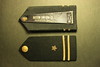
When I had originally purchased this grouping, I was told that all items are from the United States Naval Academy and from the Second World War. I looked a bit closer and noticed the curious buttons. After examining the shoulder boards and corresponding rank ladders - those of a midshipman battalion lieutenant (junior grade) - I knew spot-on that the insignia was from the MMA and from the cited period.

Here are my meandering notes:
* Interestingly, unlike USNA boards, the stars are not metal, rather woven. The shoulder boards came from a private uniform shop, "Boston Uniform Co." - it was located at 66 Chelsea St. in Charlestown, Massachusetts. The company last appeared in public records in 1958. But! Embroidered shoulder boards were not worn in the 1950s.

* The ladders are plainly marked with the Hilborn-Hamburger manufacturer's mark - "H-H" within a stylized eagle; such a mark was used on H-H insignia prior to the mid-50s. The fact that the insignia is clutch back - as opposed to pin - means that it was issued mid-war onward.

* The buttons are brass and were manufactured by Waterbury Button Co. in Connecticut. Waterbury now has its archive online; however my specific button was not present - in this case, a useful tool proved not so.

* Regarding the anchor devices: in an MMA setting, these would specify the class of wearer. Each collar insigne is unmarked. And, of the many examples present (4 pairs), they are either brass or gold-plated - you can still see the Brasso residue on a pair.

* A blacklight test would show that the cap-band is not made of synthetics, but of Mohair; the band stitching corresponds to 1940s patterns. Mohair has a distinct warp and weft; the band has the correct texture for the period.

If I hadn't the other items alongside the cap badge, I would have been hard-pressed to determine the correct era and I would have misidentified the piece as being merely a Navy ROTC or perhaps USNA hat badge. And such is the joy of collecting.


Massachusetts Maritime Academy.
Cadet hat badge, reverse.
Threaded screw and one non-rotating point (bent).
Unmarked, cast. Gold metal plate over white metal.
Circa Second World War.

mma cadet insignia group

Massachusetts Maritime Academy.
Shoulder boards.
Cadet/Midshipman Battalion Lieutenant (Junior Grade).
Wool over hard board, gold bullion woven star and rank stripes.
Brass fastener with Commonwealth of Massachusetts seal.
Manufacturer: Boston Uniform Co., Charlestown, Mass.
Circa Second World War.

mma cadet insignia group

Massachusetts Maritime Academy.
Collar insignia, class rank anchors.
Three examples, gold plate and brass.
Clutch-back.
Manufacturer: no mark.
Circa Second World War.


Massachusetts Maritime Academy.
Collar insignia, rank ladder reverse.
Cadet/Midshipman Battalion Lieutenant (Junior Grade).
Gold plate.
Clutch-back.
Manufacturer: encuse Hilborn-Hamburger mark (H-H in stylized eagle)
Circa Second World War.

Please see: Hilborn-Hamburger maker's mark on reverse of MMA rank ladder for detail.


Massachusetts Maritime Academy.
Reverse hat band, stitching detail.
Band: Mohair. Hat screw post holes, worn with stitching.
Badge plate: Leather and wool.
Circa Second World War.