Wednesday, March 10, 2010

U.S. Merchant Marine Cadet Corps


U.S. Merchant Marine Cadet Corps (pre-1942)
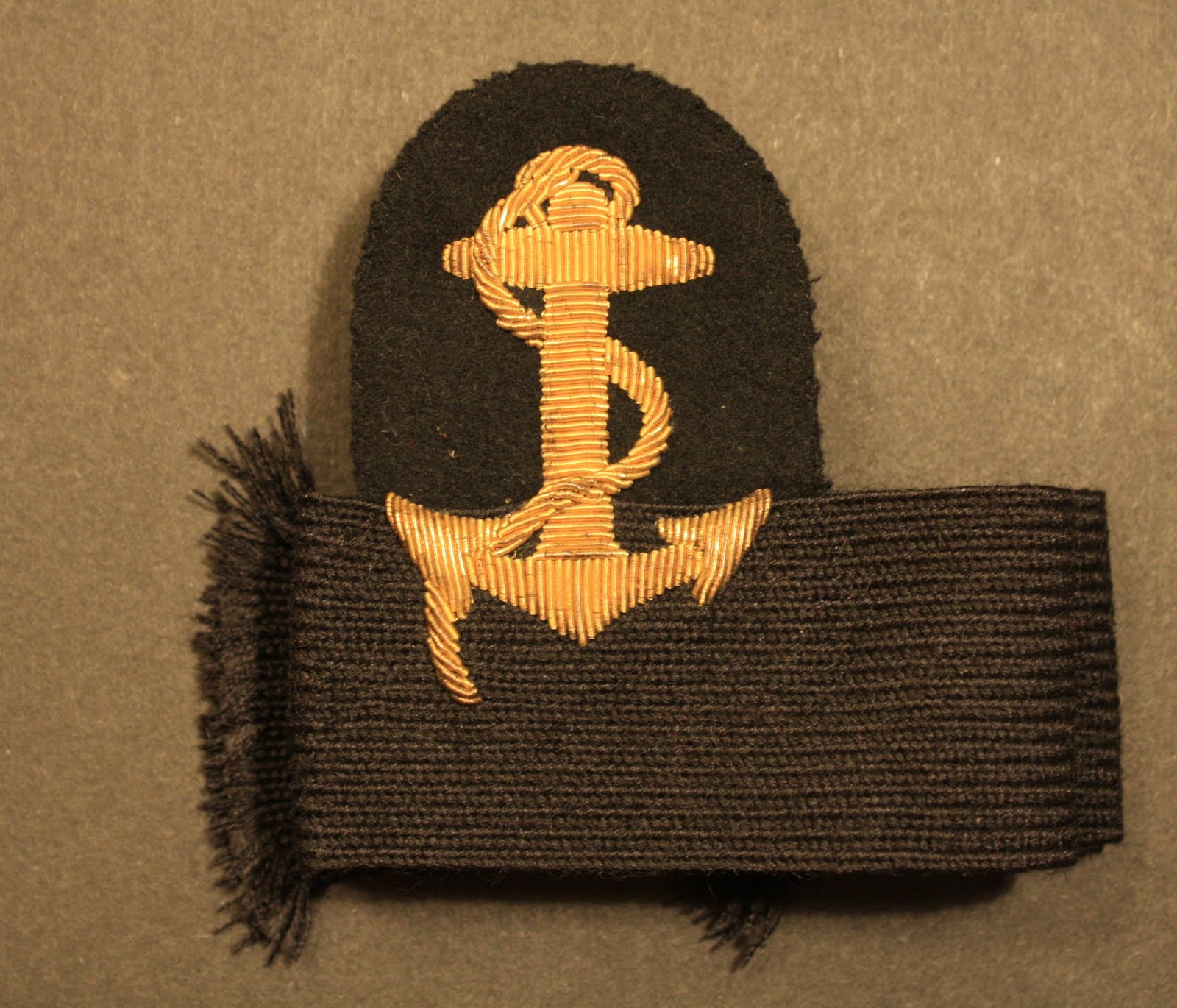
Yellow-goldenrod thread.
Embroidered anchor on wool backing and mohair band.
Pre-to-early Second World War era; 1939-1942.


From the period following the First World War through the Depression, the U.S. Merchant Shipping industry was in a shambles: once profitable companies faltered and fell, ocean-going trade evaporated and even intercoastal shipping dried up. As a result, companies went bankrupt, very few ships were built and crews manning the ships dwindled to a very few. It is also during this period that U.S. maritime unions started operating in full swing, and involved themselves in vicious internecine fighting and bitter struggles with steamship carriers. Of those seamen that survived the wreckage, their efficiency and morale was at an all time low. With the passing of the Merchant Marine Act of 1936, Congress abolished the ineffective U.S. Shipping Board and ushered in a new age for the U.S. Merchant Marine. The formerly under-regulated industry came under federal control and found itself subject to an array of programs and regulations. A few of salient features of the Act were the formulating and subsidizing the construction of U.S.-flag ships, as well as the formal training of men to man the ships.

With the passage of the Merchant Marine Act, the U.S. Maritime Commission came into being. The organization was ostensibly "to further the development and maintenance of an adequate and well balanced American merchant marine, to promote the commerce of the United States, and to aid in the national defense." It too, became embroiled in the old system of unions and steamship carrier falterings. To prop up the maritime industry, the USMC eventually bought out insolvent carriers thereby ringing whole shipping lines under federal control. With the storm clouds of war looming on the horizon, the Merchant Marine Act defined the entirety of the U.S. Merchant Marine as a military auxiliary in the event of war; furthermore, officers and crew of U.S.-flag ships could be pressed into the service of the U.S. Navy.

One of the most sweeping changes made by the act was that the Merchant Marine be "manned with a trained and efficient citizen personnel." The Act did not offer any specifics for the USMC; but soon after, the Bland Amendment of June 1938 created the United States Maritime Service for "training of licensed and unlicensed merchant marine personnel." Shortly thereafter, Congress enacted the Naval Reserve Act bringing all officers of U.S. public vessels into the U.S. Navy reserve as well as cadets (now cadet-midshipmen) at Federally-funded state maritime and the soon-to-be-created Federal system. It is worth mentioning that the U.S. Maritime Commission's first report to Congress in January 1939 suggested the establishment of a federal cadet system augmenting the pool of graduates from state and private schools - moreover along with traditional sea-handling, the system should emphasize naval science. Congress acted quickly and a series of Maritime Service cadet schools opened in the Pacific, Gulf and Atlantic coasts. Navy, Coast Guard and USMS personnel trained the cadets, with licensure remaining in the hands of the Coast Guard. With the declaration of war, the training of the Merchant Marine Cadet Corps was transferred to the Coast Guard in February 1942 and then to the War Shipping Administration in Fall of the same year.

The presented hat badge dates from the period between the founding the the Federal Merchant Marine Corps just prior to the Second World War and the institution of the U.S. Merchant Marine Academy in 1942 through the creation of the U.S. Merchant Marine Academy Cadet Corps Regiment on Dedication Day, November1943. By early 1944, midshipman-cadets began wearing midshipman hat badges mirroring their colleagues at the U.S. Navy Academy in Anapolis.  This hat badge is an embroidered anchor on a wool backing and mohair band; this specific example was removed from a hat and stored over the period of several years. Bands, such as this were an integral part of the hat to which it was affixed, and did not slide off easily as is the case with removable covers and bands of the present-day; hats were spot cleaned or taken to the cleaners. With the United States' formal entry into the war, the U.S. insignia industry servicing maritime and Naval concerns changed its means and modes of production. The older, elegant hat devices made of woven bullion and metallic thread were replaced by metal hat badges and other removable devices; although, those who had means and money continued to purchase and wear embroidered insignia. For cadets, who were rapidly moved through the federal training system, it was more expedient and cost-effective to use stamped metal devices and removable bands. This badge is the last of an era; from this point forward, stamped devices were and continue to be employed.


U.S. Merchant Marine Cadet Corps hat badge (pre-1942), obverse.
Period photographic evidence points to the fact that leading up to the Second World War and in the initial year of the U.S. Merchant Marine Academy's operation, cadet-midshipmen wore embroidered hat badges, rather supplanted by the more common stamped metal (brass, gold plated or gold fill). The presented item may be a custom piece - as the majority of cap devices of the period were comprised of metal thread (bullion) on wool backings - as opposed to silk or composite thread.  It is important to remember that the USMMCC was quite small in the period leading up to the institution of the USMM school system and uniforms were not always that - uniform - young men on the Gulf coast did not always wear the same kit as their colleagues on the West or even the East coast.


U.S. Merchant Marine Cadet Corps hat badge (pre-1942), obverse detail.


U.S. Merchant Marine Cadet Corps, pre-1942 reverse


U.S. Merchant Marine Cadet Corps cadet-midshipman, SUNY Maritime period (1939-1941).


U.S. Merchant Marine Cadet Corps cadet-midshipmen, SUNY Maritime period (1939-1941).
The cadet-midshipmen are shown photographed in working khaki manning a monomy in Long Island Sound. Note that the young gentlemen are not wearing garrison hats, pointing to the fact that this photograph is pre-Regiment. The make of their combination hats is consistent with late-1930s and early Second World War construction. Their uniform shirts lack insignia of any sort, underscoring the same.

Monday, March 8, 2010

U.S. Maritime Service Chief Petty Officer

Maritime Service CPO Hat Badge
U.S. Maritime Service Chief Petty Office hat badge (2nd design)
One piece construction. Seal, 25mm diameter; Anchor, 50mm length.
Coro (Cohn & Rosenberger) hallmark.
Anchor and device stamped brass, sterling plated (marked); red enamel band and shield.
Mid-to-post Second World War era; 1942-1947.

This is the second design of the USMS CPO hat badge; the first was worn from 1938, with the institution of the USMS training program, up until WSA control of the USMS in 1942. The former badge may be found in plain brass or gold, as well as plated silver - as is the case of this badge. The second design is always in silver plate, any other is a pattern or reproduction. The illustrated badge differs from the first with a few stylistic differences - a difference in shield configuration and the inclusion of a motto, and punctured anchor ring. The first employs blue enamel as opposed to red. Interestingly enough, the changed design did not stylistically match that of contemporary uniform coat, cap and shoulder board buttons and snaps which were altered at the same time as the hat badge.

A miniature of this device was authorized and manufactured for wear on overseas caps.


USMS CPO Hat badge, obverse.


USMS CPO Hat badge, reverse.
A close-up of the reverse details the Coro (Cohn & Rosenberger) hallmark as well as the Sterling denotation. Coro, as a corporate name came to be in 1943; however, the incuse hallmark "Coro" with a distinct curly-queue C in serif font dates to 1940 and underwent minor variations until 1945. Moreover, due to wartime metal shortages, Coro produced Sterling insignia items under Government contract from 1942-1947. With the aforementioned in mind, this hallmark adequately dates the device to the early-to-mid 1940s, contemporaneous with USMS insignia change.


USMS CPO Hat badge, production hub.
This hub is composed of hardened steel; of interest are the alignment pins used in the creation of dies. I have already written about production methods specifically outlining the purpose of a hub, here. If you visit the image's page on Flickr, and select "All Sizes", the original size can give you a better idea of the intricacy of design and even the parts of the hub that have been buffed and chiseled.

One reason that dies do not show up often in collections is that as dies wear out, they are taken out of production, defaced and melted down; hubs survive due to the fact that more than one master is required for die production. In terms of USMS hat insignia, hubs are few and far between as there were not a whole lot of insignia houses producing USMS devices.

This specific die was sourced from an estate in Rhode Island; which corresponds to the fact that this is perhaps indeed a Coro hub (see above). Prior to, during and following the Second World War, Coro had a large jewelry factory in Providence, Rhode Island. Thus far, I have only seen period USMS CPO badges with Coro hallmarks.

Sunday, February 7, 2010

War Shipping Administration

War Shipping Administration officer hat badge
Two piece construction; 60mm (l) x 55mm (h).
No hallmarks.
Eagle and shield gold-filled; anchors gold-filled.
Circa Second World War era; 1943-45.


Logistics and control of the supply chain is a perennial thorn in the side of military planners. In the interwar period, the U.S.'s sea-borne commerce was handled by a handful of independent shipping companies and corporations. With the clouds of war looming over Europe, and the with country gripped by the Depression, the federal government created the U.S. Maritime Commission so as to provide stimulus to and a regulatory framework for U.S. maritime commerce; this was welcomed by industrialists as a protectionist measure. Of its many roles, the USMC was responsible for the training of men for service in the U.S. Merchant Marine, overseeing ship construction and the militarization of the U.S.-flag fleet in the event of war.

After Pearl Harbor and in the early days of 1942, by executive order President Roosevelt created the War Shipping Administration. In one stroke, the WSA seized all U.S.-flag merchant ships for wartime duty. Among other responsibilities, the fleet chartering functions of the U.S. Maritime Commission were transferred to the new agency; by mid-war, the WSA owned and operated or chartered 80% of all sea-going merchant vessels in the U.S., with the rest being owned or chartered by the U.S. Army and Navy. An estimated 90% of all military and essential cargo were carried in WSA ships; and the Administration's responsibilities extended to all aspects and phases of shipping. This agency worked closely with Merchant Marine unions, operators, the U.S. Army and Navy as well as with the British Ministry of War Transport to ensure logistical control of the maritime supply lines. Despite service in-fighting and other institutional set-backs, the WSA did fulfill its role as to maintain ever important seaborne logistics control.

The National Archives provides the following time line and other pertinent information:
Administrative History

Established: In the Office for Emergency Management by EO 9054, February 7, 1942, under authority of the First War Powers Act (55 Stat. 838), December 18, 1941.

Predecessor Agencies:

* Division of Emergency Shipping, Office of the General Director of Shipping
* U.S. Maritime Administration (Feb. 1941-Feb. 1942)

Functions: Acquired and operated U.S. ocean vessels except those of the armed services and the Office of Defense Transportation; trained merchant crews; and coordinated utilization of U.S. shipping.

Abolished: September 1, 1946, by the Naval Appropriations Act (60 Stat. 501), July 8, 1946.

Successor Agencies: U.S. Maritime Administration.
And regarding seized functions, HyperWar provides the following text culled from a WSA memorandum penned by Adm E. S. Land:
Under the Merchant Marine Act of 1936, the United States Maritime Commission was established as an independent agency to direct and control all phases of overseas shipping and shipbuilding. It became apparent immediately when this Nation entered the war that a special agency to deal with the operational problems peculiar to war was necessary to supplement the Maritime Commission. That need brought about the creation of the War Shipping Administration on February 7, 1942, which took over from the Maritime Commission virtually all of the Commission's major statutory functions with the exception of shipbuilding. Thus WSA became the Government's ship operating agency and the Maritime Commission its shipbuilding agency.
It is important to remember that the WSA owned, operated and chartered sea-going vessels. The personnel manning these ships could be of several classes:
  • Mariners, licensed or unlicensed, union or non-union.
  • U.S. Maritime Service trained.
  • "Old salts", or mariners not federally but state trained.
  • Civil-service, civilian mariners.
  • Maritime shipping company employees.
The hat badge illustrated belonged to an employee of the WSA that worked aboard a WSA-owned and operated vessel. A bit of high-level and maritime culture is required to understand how this hat badge fits into the small constellation of sea-service and federal maritime insignia...

Since the WSA was not a uniformed service (but did have a uniformed component: the Maritime Service - which will be covered in the future), some individuals employed by the WSA proper could and did procure uniforms and insignia at their discretion. Those mariners who went to the various state maritime schools or the U.S. Merchant Marine Academy, during the war, would be inducted into the U.S. Merchant Marine as an active or reserve officer - those individuals had the privilege of wearing U.S. Maritime Service insignia - as they still do today. However, in the early days of the war, not all officers aboard ship were graduates of said schools, and would wear uniforms in the fashion of the day depending upon their status: mate, engineering officer, master, &c. (along the lines of U.S. Coast Guard licensed positions). If in the employ of a company, they would wear the company's insignia. But, if purely in the employ of the WSA, they could wear whatever struck their fancy and within reason.

WSA officer hat badges (cap devices), usually fell along the the following lines; with the important indicator of looking very similar to the U.S. Navy hat badges, albeit with "a twist":
  • A stamped or silver federal eagle with enamels or painted shield in red, white and blue. Embroidered examples of the latter also exist (these share a symbology harkening to U.S.S.B. badges - which will be illustrated in a forthcoming post).
  • A stamped federal eagle and anchors all in gold.
These hat badges are few and far between given the relatively small number of WSA officers and the eventual manning of ships by freshly-minted officers from U.S.M.S. schools or existing shipping company crew members. The latter usually kept their existing insignia or defaced U.S.M.S insignia with a company flag - as illustrated in previous entries.


War Shipping Administration officer
Hat badge, obverse.
This is ostensibly composed of components from the officer hat badges of the U.S. Navy and U.S. Public Health Service (anchors and eagle-shield, respectively). One might proffer a claim of incongruity by calling attention to the fact that the eagle is without the tell-tale "cow lick" on its crown which many use to "date" some U.S.N. commissioned officer hat badges. However, through careful examination of the toning patterns of the badge itself, the overall patina is consistent with sterling and gold-plated badges from the 1940s; and this die variation was very much in use at mid-war by Vanguard. On a stylistic note, the other encountered variation of enamels and painted shields fell into disuse or non-manufacture over the span of two years after the entry of the United States into the Second World War. The reason for this change may be that uniform shops in the major WSA embarkation ports ran out of stock and offered the illustrated alternative to move existing stock. And, since the WSA was without uniform regulations, these badges were more than likely purchased by an officer eager to adorn his cap with something distinctive.


War Shipping Administration officer
Hat badge, reverse.
Note the absence of any hallmarks of any sort; the eagle of the usual Vanguard variety and anchors of Viking in design.


War Shipping Administration officer
Hat badge, reverse bolt detail.
The slight lozenge shaped brass keeper bolt is of contemporary issue.
War Shipping Administration

Sunday, January 31, 2010

U.S. Navy commissioned officer

U.S. Navy commissioned officer hat badge, pre-1941
Two piece construction; 65mm (l) x 55mm (h).
H & H (Hilborn & Hamburg) hallmark on eagle wing. Viking hallmark on the anchor.
Eagle and shield sterling (marked); anchor gold-filled (1/10 14K GF).
Circa pre-Second World War era; late 1930s.


Following the Revolutionary War and dissolution of the Articles of Confederation, the early American republic decidedly wished to break with the aristocratic traditions of old Europe - if not in practice, then in symbolic language. Crowns were removed from coinage, royal was dropped from place names, and liberty became the byword of the era. With the birth the Federal government, the American bald eagle emblazoned with a shield representative of the first thirteen states, and clutching arrows in one claw and an olive branch in the other - not so subtle visual metaphors of both the defense and peace-providing nature of the young republic - cropped up on government seals and on military uniform buttons. Despite the desire to promote a democratic and egalitarian society, removing holdovers of rank titles and uniform clothing of a recent hierarchical and aristocratic past from the military proved exceedingly difficult - tradition dies hard, even when trying to supplant it with another (case and point: it was only after numerous bureaucratic and social changes wherein the naval rank of Admiral was finally allowed decades after independence).

The Navy, in particular, was (and still is) an organization requiring strict discipline and order in its ranks. Reticence to ape European traditions spurred the U.S. Navy to create its own socially relevant native American symbols of rank and hierarchy. Nevertheless, it fell in line with the prevailing tradition of leaves and lace. One of the more curious phenomena illustrating this is the permutations that U.S. Navy officer's hat badge has gone through over time; these also offer insight as to contemporary concerns of the U.S. Navy establishment and can be used to date items to a specific time period. Early on, the cap device denoted rank or rate through color and arrangement of woven images of live oak leaves, acorns, olive branches and other devices such as old-English letters. These show that in the period immediately preceding the Civil War, concern revolved around an officer's job aboard ship: Navy uniform regulations outlined differences in line or specialties of officers, e.g. engineers, surgeons, chaplains or deck. With the close of the Civil War, Federalism was the rule in the governance of the United States, and the strength of the Union was represented even more so than before on naval insignia. The elaborate differences once found on commissioned officers headgear gave way to an elegant and uniform means of identification: an eagle-anchor device worn on a uniform cap centered above the visor. This device served as a potent visual statement of how officers were in the service of the government, and not merely members of a ship - those indicators found themselves on the sleeve and epaulets. Plates in the 1869 regulations illustrated a gaunt republican eagle facing the wearer's left and surmounting a large United States shield in silver with embroidered gold anchors underneath. A definitive statement on the device's construction was published in 1889; afterward, it went through small manufacturer design changes until the publication of the Uniform Regulations of May 13, 1941. Previously, as stated before, the eagle faced to the left whereas the new regulations stated that the eagle face right. A memorandum from the Director of Naval History to Commander-in-Chief, U.S. Naval Forces, Europe of 13 December 1963 states that:
The shift of the eagle's aspect to right-facing from left-facing is logical from the perspective of heraldic tradition, since the right side (dexter) is the honor side of the shield and the left side (sinister) indicates dishonor or illegitimacy.
I am sure the original configuration was nothing that serious. It was most probably due to a manufacturer creating a product, it selling at the right price and the design continuing to be used without anyone thinking about the possible sinister repercussions or undertones. I imagine the subject was brought up at a garden party and later memos were typed and decisions were made...

The stamped metal eagle accompanying this entry is from the period immediately preceding the entry of the United States into the Second World War; it is also during this period that Hilborn-Hamburger began hallmarking insignia with the distinctive H-H in a stylized eagle-star device, and also when Viking began producing anchors for officers' insignia. Unlike other times of earlier uniform change, personnel of Navy during mid-twentieth century quickly adopted insignia as dictated by new regulations and few sailors found themselves contrary to regulation. This eagle was not worn during the war; it found its way into a cigar box and was secreted away for decades. Although, regarding the expedient change of insignia... apparently flag officers were exempt or just very slow to change as seen in these LIFE snippets from 1941 and 1942:


Adm. King is detailed on 24 November 1941 (p 92).


J. Auld is curious about the hat badge on 15 December 1941 (pg 2).


Adm. Leahy apparently hasn't updated his wardrobe by 28 September 1941 (cover).

Some design notes: this hat badge is convex and has two screw posts; one small, behind the eagle's breast, and another, larger holding the shield and anchors together. Toward mid-war, the former screw all but disappeared and was replaced by two pins near the wing tips - as can be discerned here. This eagle's body is similar in design to the U.S. Army Transportation Corps - Water Division hat badge which appeared in 1944. The aforementioned eagle was almost exclusively manufactured by Gemsco. This anchor design continued to be employed until the Korean War by jewelers and private-purchase insignia houses.

References:
James C. Tily, The Uniforms of the United States Navy.
Cranbury, NJ: Thomas Yoseloff, 1964.


U.S. Navy commissioned officer.
Hat badge, obverse.


U.S. Navy commissioned officer.
Hat badge, reverse.


U.S. Navy commissioned officer.
Hat badge, reverse detail.
Some details of note are the notches on the shield for the flush placement of the anchor stock and chain, and the presence of the convex washer. Later varieties lack notches, and the anchors are placed behind the eagle-shield device; at times slightly bending the anchors. The washer has also changed through time and has become flat - which it is at present.


U.S. Navy commissioned officer.
Hat badge, reverse hallmark detail.
Note the H-H hallmark on the reverse of the right wing and Sterling on the left. The Viking hallmark is on the left anchor stock; in later designs, Viking placed hallmarks on the anchor shank and sometimes on the arms. I have yet to determine an adequate chronology for Viking hallmark placement.


Sunday, December 6, 2009

U.S. Navy Technician

usn us technician

USN Technician hat badge & miniature device.
Cast brass; motto: U.S. TECHNICIAN.
1 screw, 1 non-rotating point.
37mm x 48mm (LxH).
manu: Officer's Equipment Co. Madison, NJ.
mini device: 15mm x 19mm.
Circa 1950.

Joseph Tonelli's book, Visor hats of the United States Armed Forces: 1930-1950 illustrates one of the most exquisite pieces of headgear worn by U.S. forces in the Second World War - that of the  U.S. Technician attached to the U.S. Navy. A passing glance could mistake it for something out of Fascist Italy: these hats have elaborate devices composed of a silver embroidered spread eagle. It faces dexter with a stylized wrench clutched in the left claw and an olive branch in the right. The lettering "U.S. TECHNICIAN" is centered on a brass or gold-plate device on the eagle's chest. The hat's chin-strap changed from gilt to black-braid by end of the war, and finally black leather. The last U.S. Technician hat Tonelli details on page 198 is from 1950 and presumably one in contemporary use.

With the onset of the Second World War, the technologies involved in weapon creation oftentimes surpassed the basic training of sailors, soldiers and their commanding officers. The technical advancements in aviation, computers, and RADAR required technical personnel of defense industry companies that created these new weapons of war to advise and train their military customers. The Navy, keen on maintaining hierarchical relationships and following Geneva Convention rules, and to insure the clear identification of non-combatants in its midst, drew up regulations for U.S. Navy Technician uniforms and devices. These regulations, for the most part, remain on the books and can be found buried in U.S. Navy and U.S. Marines uniform regulations. A survery of these regulations are as follows:

First public mention of the uniform was published by All Hands in October 1943:
New Insignia For Civilian Technicians

Civilian technicians, who may serve with the Navy, were authorized last month to wear a uniform similar to that worn by Naval officers, minus any insignia of rank or corps, or shoulder or sleeve marks. Caps with black chin strap and without cap device will be worn. Instead of Naval insignia, technicians will wear the insignia pictured herewith, on the left breast pocket of coat and shirt. (Details in N. D. Bul. [semimonthly], of 1 September 1943, R-1368.)

The insignia above was reproduced on uniform visor cap with a small gilt placard bearing the words "U.S. Technician" on the eagle's chest (detail toward the end of the post). By 1950, the elaborate device was no longer and was replaced with a gilt placard. All Hands also relates the same:
Navy Civilian Technicians Will Wear Uniforms With Emblem on Left Breast

A new directive authorizes civilian technicians serving with the Navy to wear uniforms that, except for insignia, are the same as an officer’s outfit.

For the most part, the uniforms will be worn by expert field engineers and scientists sent to Navy ships and shore bases by commercial companies to iron out difficulties the Navy is having with their equipment, Their most noticeable insignia, an embroidered badge about three inches square which shows an eagle and the words "U. S. Technician," will be worn on the left breast pocket of coats and khaki shirts. The uniform will be the same as a commissioned naval officer’s with the exception that no distinctive rank, corps device or other naval insignia will be worn. Plain buttons of the same size and color of naval officers’ uniforms will be worn on the coats. Here are the various insignia to watch for:


  • Cap insignia - Gilt badge one-and-a-half inches wide and one-and-seven-eighths inches high bearing the words "U.S. Technician," worn on the band of the combination cap with a plain black strap and plain gilt buttons.
  • Breast insignia - An embroidered badge three-and-a-quarter inches square. An eagle is shown clutching a group of tools in one claw and an olive branch in the other. The design and the words "U.S. Technician" are white on blue coats and blue on other coats and khaki shirts, on a background the same color as the coat or shirt.
  • Collar insignia - Gilt pin five-eighths of an inch wide and threequarters of an inch high bearing the inscription "U.S. Technician," for wear on both sides of the khaki shirt collar.
  • Garrison cap insignia - Same gilt pin as that worn on the collar. On the garrison cap it is worn on the left side only.
  • As announced in BuPers Circ. Ltr. 142-50 (NDR, 31 Aug 1950), the uniform will be of benefit in establishing the technician’s status in event of capture by an enemy, will provide ready identification as contractors’ representative at naval activities, and will assist area commanders and commanding officers in their control over them.

    The wearing of this uniform is limited to individuals authorized and designated by the Chief of Naval Operations.
    By the 1990s, the uniform regulation for U.S. Navy Technicians became quite specific, and they were mandated to only wear uniforms in forward combat areas and during travel to and from such areas outside of the continental United States (or, on any other occasion as deemed fit by the Chief of Naval Operations). This is to establish their official status as a non-combatant.

    U.S. Navy OPNAV INSTRUCTION 5720.3D § 9 states thus:

    Articles of Uniform. The articles of uniform shall be the same as those prescribed for a commissioned naval officer except that no distinctive rank, corps device, or other naval insignia shall be worn. Plain buttons of the same size and color prescribed for naval officer’s uniforms shall be worn on coats. Female technicians shall wear either the garrison cap or beret; combination hat is not authorized.

    Breast Insignia. An embroidered badge 3¼ inches square, consisting of a spread eagle, facing dexter; the left claw of the eagle shall be shown clutching a group of tools and the right claw an olive branch; immediately underneath the eagle shall be the letters: U.S. TECHNICIAN. The background of the badge shall be the same color as the coat/jacket or shirt, with the design and lettering white on blue coats and blue on other coats/jackets and khaki shirts. The breast insignia shall be worn on the left breast pocket of coats and khaki shirts for male technicians. The breast insignia shall be worn above the left breast pocket flap of the jacket (Service Dress Blue), for female technicians.

    Cap insignia for male technicians. A gilt badge 1¼ inches wide by 1-7/8 inches high bearing the inscription U.S. TECHNICIAN. Worn on the band of the combination cap with plain black chin strap and plain gilt buttons. Cap insignia for garrison cap (male and female technicians) and beret (female technicians). A gilt pin 5/8-inch wide by ¾-inch high bearing the inscription U.S. TECHNICIAN. Worn on the left side of the garrison cap 2 inches from the front edge and 1½ inches from the bottom edge of the cap when the garrison cap is prescribed for wear by naval officers. For female technicians, worn on the beret, aligned approximately above the left eye.

    Collar insignia. A gilt pin 5/8-inch wide by ¾-inch high bearing the inscription U.S. TECHNICIAN. Worn on both sides of the collar of the khaki shirt with the center of the insignia 1 inch from the front edge and 1 inch below the upper edge of the collar for male technicians. Worn on the white shirt collar with the center of the insignia 2 inches from the fold line at top of collar and ¾-inch from the forward edge of collar, for female technicians.
    The U.S. Marine Corps has similar directives, however without the "combination hat" and the stipulation that anyone wearing a Marine Corps uniform must abide by USMC grooming standards.

    These directives are still in effect. In terms of the insignia that accompany this entry, they were manufactured prior to the Korean War - as evident by the lack of Institute of Heraldry (IOH) numbers and the wartime keeper screw bolt. In the past, GEMSCO and Officer's Equipment Co. manufactured U.S. Technician insignia; Dondero is presently the only supplier of the collar insignia to the USMC - I am unsure about the hat badge and if it is even produced. I have yet to see these plain buttons.

    References:
    Marine Corps Order P12304.1, 25 October, 1993
    Contractor Engineering and Technical Services Personnel Manual.

    Marine Corps Order P1020.34G MCUB, 31 March 2003.
    Paragraph 8005, Civilians Serving With Marine Corps Units.

    Office of The Chief of Naval Operations OP-09B23T, 1 June, 1994
    U.S. Department of Defense Form DOD-OPNAVINST-5720-3D, § 9.

    Nicole A. Lavine. "Tactical Safety Specialist diffuse potential hazards" in Observation Post. Twentynine Palms, California: 26 January 2007, p. A5.

    Joseph J. Tonelli.  Visor hats of the United States Armed Forces: 1930-1950.  Atglen, Pennsylvania:  Schiffer Publicartions, 2003.

    U.S. Navy. All Hands October 1943, p. 69.

    U.S. Navy. All Hands November 1950, p. 51.


    USN Technician
    Hat badge & miniature device; reverse, hallmark and screw post detail. 1950s.


    USN Technician.
    U.S. Navy officers' hat with U.S. Technician insignia
    manu: Berkshire, New York, NY.
    Circa Early Second World War


    This khaki covered hat would have been worn with the jacket as detailed below. The hat itself has an early wartime Berkshire logo, and is the standard U.S. Navy officer model; the owner would have had to privately purchase the embroidered insignia. The rich embroidery is worth mentioning; it is speculated that the work was done in Great Britain - however, these findings are inconclusive.

    Do note the U.S. Navy side buttons holding the chin strap - which is of the same width as those found on standard U.S. Navy officer hat.


    U.S. Navy Technician hat


    USN Technician.
    Breast cloth badge; obverse & reverse.
    Circa 1950.


    usn technician


    As previously mentioned, a great majority of U.S. Navy Technicians worked in the field of RADAR & ASDIC (SONAR), computational devices and propulsion systems newly adopted by the U.S. Navy over the course of the Second World War and continued to do so after the close of hostilities.

    However, researchers and collectors oftentimes come across "emergency rates" or other insignia worn by sailors during this period who worked with the same technologies. The lower rates were hand-picked as evidenced by special aptitude during seamen training. The others were directly recruited by the U.S. Navy based upon prior civilian experience or training - they often became Petty Officer First Class or Chief Petty Officer after having completed boot camp; at the time, these CPOs were derisively called "Slick Sleeve Chiefs" due to the lack of service hash-marks. Directly-inducted Warrant Officers and newly-minted junior officers out of V-7 training with specialized knowledge were placed into special trade and officer corps groups (former and later). However, U.S. Technicians were another class entirely, they "belonged" to their corporations, had no military training and were "lent" for the duration to train or advise the later, repair or install their equipment or simply to operate it.

    A means to determine a wartime and post-war U.S. Technician patch is the lack of a border on the former.


    USN Technician.
    Breast cloth badge; obverse.
    From the collection of David Collar.

    Note: The eagle is clutching arrows as opposed to a wrench.

    usn technician


    USN Technician.
    Khaki Coat
    circa Second World War


    Despite regulations stating otherwise, this belted khaki coat has U.S. Navy officer gold buttons. The main difference between this jacket and its naval and maritime counterparts is the fact that it lacks loops for shoulder boards. It was also an expediently tailored piece as it not only lacks an interior liner, but also interior pockets - this common to other period pieces. The buttons are removable for coat cleaning in ship's laundry.

    Note: The eagle is clutching a wrench (of sorts) and a hammer.


    USAAF Technician.
    Silver plate; motto: U.S. TECHNICIAN.
    Silver plate; lettering: A.S.C..
    device: 15mm x 19mm.
    Reverse: non-rotating points.
    manu: no hallmarks or silver content noted.
    Circa Second World War through 1947 (n.b. ASC became AMC in Dec. 1947).
    from the collection of Joe Weingarten.

    Rarely seen, these silver collar devices were worn by civilian technicians attached to the U.S. Army Air Forces Air Service Command at installations such as Wright Field - from 1948, Wright-Patterson Air Force Base. These technicians began working at Wright-Patterson from the Second World War through the Vietnam war when they were replaced by civilian civil service employees of the U.S. Air Force Material Command. They performed tasks much like their U.S. Navy counterparts; if such insignia is still worn or used, I am unaware.


    Korean War Period, U.S.A.F. Technician shirt patch.

    More on the USAAFASC activities at Wright-Patterson, may be found here.

    Sunday, November 22, 2009

    Massachussetts Maritime Academy

    The late 1800s saw a flurry of state nautical school openings with funds provided by U.S. Congress. One of them, the Massachusetts Maritime Academy began its life as the Massachusetts Nautical Training School in 1891. In 1913, along with training vessel and curriculum changes, its the name changed to the Massachusetts Nautical School. And, along with its move to Hyannis from Boston in 1942, its name changed its present form.


    The Second World War saw many changes in the structure of MMA corps of cadets. Like other state and federal maritime schools and academies, cadets were ushered into a rush program of 16-18 months from matriculation to graduation. America's entry into the war called for an increased number of men to serve on the many convoy ships, merchantmen, and ocean-going vessels either under construction or underway. The US Navy instituted the v-12 program whereby to increase the number of young men joining the ranks of the Navy's officer corps.

    With each change in name, MMA's cadet insignia changed, with the exception of uniform buttons. The buttons depict the central device of seal of the Commonwealth of Massachusetts. MMA's hat and uniform insignia have mirrored those of the U.S. Naval Academy, albeit with hat badges having "M.N.T.S." and "M.N.S." above the anchor; if you look at this page, you can see an example of the later. In the 1940s until the present, MMA has used insignia indistinct from the USNA - including the abandonment of woven for metal anchor devices on hats. It is the aforementioned indistinct insignia that has prompted this entry and a means for sleuthing an insigne's period.

    When I had originally purchased this grouping, I was told that all items are from the United States Naval Academy and from the Second World War. I looked a bit closer and noticed the curious buttons. After examining the shoulder boards and corresponding rank ladders - those of a midshipman battalion lieutenant (junior grade) - I knew spot-on that the insignia was from the MMA and from the cited period.

    Here are my meandering notes:
    * Interestingly, unlike USNA boards, the stars are not metal, rather woven. The shoulder boards came from a private uniform shop, "Boston Uniform Co." - it was located at 66 Chelsea St. in Charlestown, Massachusetts. The company last appeared in public records in 1958. But! Embroidered shoulder boards were not worn in the 1950s.

    * The ladders are plainly marked with the Hilborn-Hamburger manufacturer's mark - "H-H" within a stylized eagle; such a mark was used on H-H insignia prior to the mid-50s. The fact that the insignia is clutch back - as opposed to pin - means that it was issued mid-war onward.

    * The buttons are brass and were manufactured by Waterbury Button Co. in Connecticut. Waterbury now has its archive online; however my specific button was not present - in this case, a useful tool proved not so.

    * Regarding the anchor devices: in an MMA setting, these would specify the class of wearer. Each collar insigne is unmarked. And, of the many examples present (4 pairs), they are either brass or gold-plated - you can still see the Brasso residue on a pair.

    * A blacklight test would show that the cap-band is not made of synthetics, but of Mohair; the band stitching corresponds to 1940s patterns. Mohair has a distinct warp and weft; the band has the correct texture for the period.

    If I hadn't the other items alongside the cap badge, I would have been hard-pressed to determine the correct era and I would have misidentified the piece as being merely a Navy ROTC or perhaps USNA hat badge. And such is the joy of collecting.


    Massachusetts Maritime Academy.
    Cadet hat badge, reverse.
    Threaded screw and one non-rotating point (bent).
    Unmarked, cast. Gold metal plate over white metal.
    Circa Second World War.

    mma cadet insignia group

    Massachusetts Maritime Academy.
    Shoulder boards.
    Cadet/Midshipman Battalion Lieutenant (Junior Grade).
    Wool over hard board, gold bullion woven star and rank stripes.
    Brass fastener with Commonwealth of Massachusetts seal.
    Manufacturer: Boston Uniform Co., Charlestown, Mass.
    Circa Second World War.

    mma cadet insignia group

    Massachusetts Maritime Academy.
    Collar insignia, class rank anchors.
    Three examples, gold plate and brass.
    Clutch-back.
    Manufacturer: no mark.
    Circa Second World War.


    Massachusetts Maritime Academy.
    Collar insignia, rank ladder reverse.
    Cadet/Midshipman Battalion Lieutenant (Junior Grade).
    Gold plate.
    Clutch-back.
    Manufacturer: encuse Hilborn-Hamburger mark (H-H in stylized eagle)
    Circa Second World War.

    Please see: Hilborn-Hamburger maker's mark on reverse of MMA rank ladder for detail.


    Massachusetts Maritime Academy.
    Reverse hat band, stitching detail.
    Band: Mohair. Hat screw post holes, worn with stitching.
    Badge plate: Leather and wool.
    Circa Second World War.

    Friday, October 23, 2009

    S/T Ocean Eagle

    In case you're curious about the header image, that is the Liberian Tanker Ocean Eagle sinking in the harbor off of San Juan, Puerto Rico on 3 March 1968.

  • NOAA Report
  • Office of Naval Research Oceanic Biology Program Report

  • The accident was devastating to local ecosystems as it was the most severe oil spill experienced in U.S. territorial waters up to that time; in its wake came improved methods for containing spills and improved tanker safety practices.

    I have gone through various U.S. government publications, however they are careful to remove references to owners and the name of the ship's captain. If anyone might know of the shipping company that manned the ship at the time of the accident, I would be keen to obtain their hat badge.

    American-Hawaiian Steamship Company

    American-Hawaiian SS Co. hat badge.

    Faint H & H (Hilborn & Hamburg) hallmark on eagle wing. Gemsco hallmark on flag. Eagle and shield sterling plate over copper; wreath brass/gold-plate. Second World War era.

    badge: 60mm x 65mm
    flag: 25mm x 22mm

    As follows is an essay on the history of American-Hawaiian Steamship Company. Collecting the data on this specific company is somewhat responsible for the prolonged hiatus in blog postings. I hope that the history behind the badge warrants the absence of images. More images will follow in a couple of weeks... I'm going on vacation for a spell.


    American-Hawaiian Steamship Company (A-H SS Co.), 1899-1956.

    The story of American-Hawaiian Steamship Company mirrors the fates of several large steamship houses in the United States: scramble for capital, flowering of activity, failed business models, take-over by a large conglomerate and final dissolution. A-H SS Co. is unique in the fact that at one point it had the largest U.S.-flag merchant fleet and then dwindled to nothing.

    A-H SS Co. was engaged in intercoastal (U.S. Atlantic-to-U.S. Pacific coast) and foreign trade - although, as it name implied, it originally provided the majority of the steamship freight service between the mainland United States and the Hawaiian Islands. After the annexation of the Hawaiian Islands by the United States on 7 July 1898, George S. Dearborn, who owned a fleet of sailing vessels, decided to establish a modern steamship service between New York and Hawaii. In order to finance this venture, he sold his fleet of sailing ships and raised additional capital from investors - notably his brother-in-law, Lewis Henry Lapham. Almost a year later, on 7 March 1899, Dearborn organized the American-Hawaiian Steamship Company. Dearborn served as president of the company, with Captain William D. Burnham as general manager - Dearborn was president until his death in 1920; Burnham held his appointed post until 1914.

    Immediately after incorporation, A-H SS Co. ordered new steamships from the local New York and New Jersey shipyards, with Dearborn securing contracts to bring sugar to the U.S. mainland from the Big Five (the main business conglomerates in the islands). Service was to begin in 1900, however A-H SS Co. found its ships requistioned by the U.S. Navy for emergency duty to counter the Boxer Rebellion in China. Only in January 1901 did the promised service begin. For the next 14 years, under the protective umbrella of U.S. cabotage laws, the relationship that A-H had forged with the Big Five proved mutually beneficial and was source of prosperity to the company's U.S.-flag ships.

    Of the of several innovations A-H SS Co. ushered into the steamship trade, starting with their first voyage, A-H SS Co. steamships used the Straits of Magellan rather than the longer route followed by sailing vessels around Cape Horn. A problem that faced steamships in the long voyage from New York to Hawaii was the logistic problem of coaling. Although Chile was a natural stop off point for re-supply, Chilean coal was of low-quality and quickly exhausted. This very problem vexed the great powers of the period, and colonial history is rife with seemingly far-flung islands annexed for the very purpose of servicing navies. A-H SS Co. did not have the luxury of arms, therefore resorted innovation. Alternatively, A-H SS Co. supported the efforts of Valdemar Frederick Lassoe, its chief engineer, to develop an oil burner for the company's steamships. The oil burner was first fitted in the S.S. Nebraskan, which completed its first voyage from the Pacific to New York in 1904; the results so impressed the U.S. Navy that it launched a program to convert warships from coal to oil.

    In January 1907 A-H SS Co. took advantage of the opening of the Tehuantepec Railroad across Mexico to divide its ships into two fleets: one operated on the Pacific Ocean, while the other fleet handled the cargo on the Atlantic between New York and Tehuantepec. This arrangement lasted until 1914, when revolutionary turmoil in Mexico shut down the Tehuantepec Railroad; while the opening of the Panama Canal on 15 August 1914 provided an economical alternative. However, landslides closed the Panama Canal between 13 September 1915 and 15 April 1916, thus forcing A-H SS Co. to use the Straits of Magellan one last time - albeit under oil power.

    The company's heyday was in this early period. With its offices at 8 Bridge Street Maritime Building in New York, A-H SS Co. steamers sailed from the renovated Pier 56, Bush Terminal, South Brooklyn, every six days laden with freight for Pacific Coast Ports and the Hawaiian Islands. Through bills of lading, cargo was accepted for Puerto Mexico and all points along the Tehuantepec National Railway, Vera Cruz & Isthmus Railway, Pan-American Railway and ports along the west coast of Mexico and Central America. From Hawaii and San Francisco, steamers left for New York every twelve days. The company used San Francisco and Puget Sound as a way station for freight destined for Vera Cruz and New York. Commerce was good.

    The positioning of the company in the Hawaiian trade could not have been more secure, yet when the First World War began in 1914, Dearborn gradually succumbed to the temptation of chartering out most of his fleet in order to profit from the record-high freight rates in the North Atlantic. In 1916 A-H SS Co. announced that it would suspend handling the sugar crop of the Islands; not surprisingly the Big Five and the Territorial Government of Hawaii felt betrayed. As a reprisal, the Big Five vowed that A-H SS Co. would never be able to return. Henceforth, the Matson Navigation Company, enjoying the full support of the Big Five, emerged as the principal ocean carrier of the Islands. Once the wartime profits evaporated, A-H SS Co. realized it had foolishly abandoned long-term stability for the sake of short-term gains - the company did keep its original name, in the hope of returning one day to Hawaii, but more as a reminder of the prosperous days when it had been the largest U.S.-flag merchant fleet.

    In 1920, after the government returned the vessels requisitioned during the war, A-H SS Co. decided to dedicate its fleet in intercoastal trade, mainly between New York and California. After Dearborn died on 28 May 1920, W. Averell Harriman became the principal stockholder of the company and assigned the management of the company to his United American Lines; all of this he affected in April 1920. The attempted merger proved more complex than expected, and soon Harriman realized that the financially troubled A-H SS Co. required its own separate organization, and to that end he appointed Cary W. Cook as its president on 20 March 1923. As a condition for accepting the job, Cook had specified that the company's headquarters be moved from new York City to San Francisco - not only because this was where he lived, but also because he felt the future of the company was in the Pacific. Cook put A-H SS Co. back on solid footing and also began the negotiations with the Grace Line - which was keen to sell its six vessels on the unprofitable intercoastal service. The purchase was concluded in June 1925 by Roger D. Lapham, who succeeded Cook as president that same month. The intercoastal route sailed every five days. As a further step to consolidate A-H SS Co. position as the leading intercoastal carrier, Lapham acquired one of its competitors, the Williams Line, in early 1929.

    Unfortunately, the intercoastal trade was proving to be rather unstable and subject to sharp rate wars, so Lapham correctly concluded that the company needed to enter into other trade routes. His most important move was the creation of the Oceanic & Oriental Navigation Company in 1928 to take over a line of U.S. Shipping Board vessels (USSB); A-H SS Co. and Matson each had a 50% stake in the venture, with Matson managing the government ships on the the Australia/New Zealand route, and A-H SS Co. managing those sailing to China, Indochina, Japan and the Philippines. When the Great Depression struck, A-H SS Co. was in an especially difficult state as the intercoastal trade so closely reflected the collapse of the American economy; Lapham considered a merger with the Dollar Line in 1930, but the negotiators failed to find a satisfactory arrangement. Ever the opportunist, in 1936, did Lapham purchase four steamers from the Dollar Line for A-H SS Co. as Dollar was desperately trying to remain solvent and not slip into bankruptcy.

    The U.S. government requisitioned the ships of A-H SS Co. and of all other lines during Second World War. The company received a War Shipping Pennant in 1944 with four stars - "4 Star Companies" were assigned anywhere from 75-100 vessels of Victory Fleet during the Second World War. Once the war was over, the company did not want the surviving ships back, which in any case were overage, and instead preferred to bareboat charter government vessels for the intercoastal trade and for a service to the Far East, at least until the post war shipping situation became clearer. After the war, these cast-off ships ended up as troopships for the MSTS or found service in the U.S. Navy. Despite not wishing to have its assets returned, A-H SS Co. did engage in litigation to recoup perceived losses at the hands of the U.S. Government. A particularly visible case was of the Alaskan, the Federal Courts upheld the Government's payment to A-H SS Co., claiming the A-H SS Co. was attempting to profit from war.

    With the ascension of Roger Lapham's son, Lewis A. Lapham, because the president of the company in 1947, his first action was to move the headquarters back to New York City from San Francisco. The company was wisely keeping its options open, but the Korean War panicked A-H SS Co. into buying six surplus ships on the mistaken assumption that high freight rates would continue indefinitely (obviously lessons were not learned from previous of the same sort). The ships had barely been brought when the intercoastal service took a downward plunge, and with each voyage piling up losses, the company had no choice but to suspend the intercoastal service in March 1953. For all intents and purposes, A-H SS Co. was no longer sailing.

    The question of what to do with the idle fleet vexed the stockholders, who reached the conclusion that the hope left was to shift to a foreign flag of convenience. Because the company had exclusively operated under the U.S. flag, the stockholders decided to bring in as an investor the billionaire Daniel Ludwig, whose experience with foreign-flag operations was renowned. Ludwig decided to use the company for his own plans, and in 1955, after a bitter takeover battle, he gained full control and sold off the ships and most of the assets of A-H SS Co., whose steamship career ended at this point.

    Ludwig, however, for purposes of tax advantages, kept A-H SS Co. as a paper company and involved it in real estate ventures. For the next ten years the company became embroiled in sundry schemes: first to build Roll-On/Roll-Off vessels, then container ships and finally nuclear-powered vessels. By 1968 the last of these schemes had failed, and Ludwig proceeded to liquidate A-H SS Co. as a first step toward making an extremely lucrative deal with Sea-Land.

    Principal Executives
    George S. Dearborn :1899-1920
    William D. Burnham : 1899-1914
    Cary W. Cook : 1923-1925
    Roger D. Lapham : 1925-1944
    John E. Cushing : 1938-1947
    Edward P. Farley : 1944-1955
    Lewis A. Lapham : 1947-1953

    House Flag:
    The A-H SS Co. house flag first appeared in publications in 1926; the flag was simply the white initials A-H on a blue field. After the takeover, the flag was never flown again as American-Hawaiian Steamship Company became a paper company; and in the 1970s nevermore.

    References:
    Thomas C. Cochran and Ray Ginger, "The American-Hawaiian Steamship Company, 1899-1919," Business History Review (Boston: The President and Fellows of Harvard College) 28 (December 1954): 342-365

    Rene De La Pedraja, Rise and Decline of U.S. Merchant Shipping in the Twentieth Century (Twayne's Evolution of Modern Business Series). New York: Twayne, 1992.

    Penton Publishers, Blue Book of American Shipping (17th Ed.). New York, New York: Penton Publishers, 1913. pp. 315, 324.

    New York Times, 26 November 1948, 28 February 1953.

    Pacific Marine Review, November 1926.

    Jerry Shields, The Invisible Billionaire: Daniel Ludwig. Boston: Houghton Mifflin, 1986.

    War Shipping Administration, PR 2029. 24 September, 1944.

    F. J. N. Wedge, Brown’s Flags and Funnels. Brown, Son & Ferguson: Glasgow, 1926.

    Lloyd's, Lloyd's House Flags and Funnels. Lloyds: London, 1912.
    Facsimile edition available here:
    http://www.lulu.com/content/paperback-book/lloyds-house-flags-and-funnels-1912/8504627

    Legal cases:
    American-Hawaiian Steamship Co. v. United States. the Alaskan
    United States Court of Appeals Second Circuit. - 191 F.2d 26
    Argued May 8, 1951 Decided August 13, 1951

    Marvyn Gould, Executor of the Estate of J. Donald Rogasner,et al., Appellants in No. 75-1338. v. American-Hawaiian Steamship Company et al., Cross-appellants
    United States Court of Appeals, Third Circuit. - 535 F.2d 761
    Argued Oct. 3, 1975.Decided April 8, 1976