Showing posts with label "u.s. maritime commission". Show all posts

Wednesday, March 10, 2010

U.S. Merchant Marine Cadet Corps


U.S. Merchant Marine Cadet Corps (pre-1942)
Yellow-goldenrod thread.
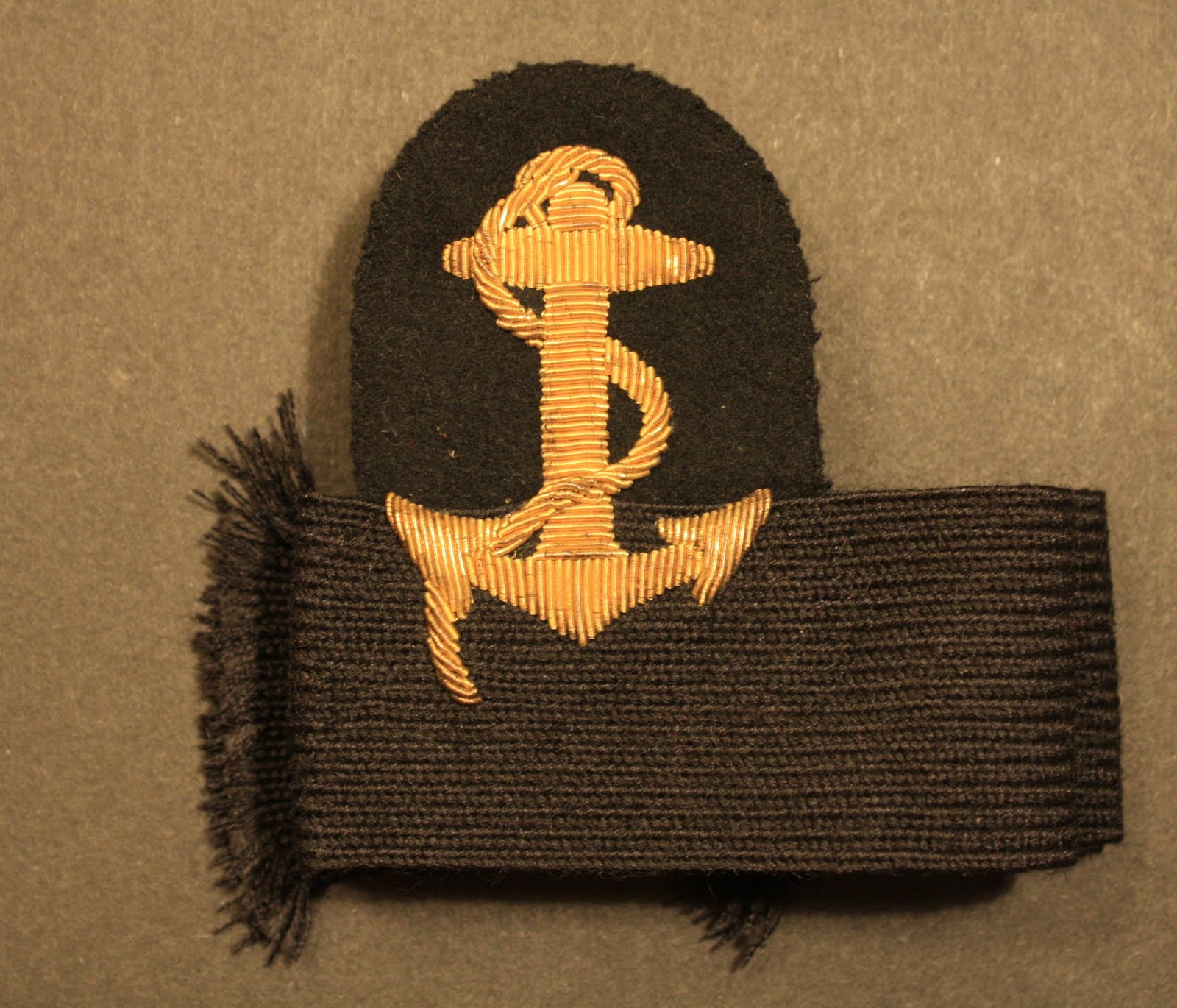
Embroidered anchor on wool backing and mohair band.
Pre-to-early Second World War era; 1939-1942.


From the period following the First World War through the Depression, the U.S. Merchant Shipping industry was in a shambles: once profitable companies faltered and fell, ocean-going trade evaporated and even intercoastal shipping dried up. As a result, companies went bankrupt, very few ships were built and crews manning the ships dwindled to a very few. It is also during this period that U.S. maritime unions started operating in full swing, and involved themselves in vicious internecine fighting and bitter struggles with steamship carriers. Of those seamen that survived the wreckage, their efficiency and morale was at an all time low. With the passing of the Merchant Marine Act of 1936, Congress abolished the ineffective U.S. Shipping Board and ushered in a new age for the U.S. Merchant Marine. The formerly under-regulated industry came under federal control and found itself subject to an array of programs and regulations. A few of salient features of the Act were the formulating and subsidizing the construction of U.S.-flag ships, as well as the formal training of men to man the ships.

With the passage of the Merchant Marine Act, the U.S. Maritime Commission came into being. The organization was ostensibly "to further the development and maintenance of an adequate and well balanced American merchant marine, to promote the commerce of the United States, and to aid in the national defense." It too, became embroiled in the old system of unions and steamship carrier falterings. To prop up the maritime industry, the USMC eventually bought out insolvent carriers thereby ringing whole shipping lines under federal control. With the storm clouds of war looming on the horizon, the Merchant Marine Act defined the entirety of the U.S. Merchant Marine as a military auxiliary in the event of war; furthermore, officers and crew of U.S.-flag ships could be pressed into the service of the U.S. Navy.

One of the most sweeping changes made by the act was that the Merchant Marine be "manned with a trained and efficient citizen personnel." The Act did not offer any specifics for the USMC; but soon after, the Bland Amendment of June 1938 created the United States Maritime Service for "training of licensed and unlicensed merchant marine personnel." Shortly thereafter, Congress enacted the Naval Reserve Act bringing all officers of U.S. public vessels into the U.S. Navy reserve as well as cadets (now cadet-midshipmen) at Federally-funded state maritime and the soon-to-be-created Federal system. It is worth mentioning that the U.S. Maritime Commission's first report to Congress in January 1939 suggested the establishment of a federal cadet system augmenting the pool of graduates from state and private schools - moreover along with traditional sea-handling, the system should emphasize naval science. Congress acted quickly and a series of Maritime Service cadet schools opened in the Pacific, Gulf and Atlantic coasts. Navy, Coast Guard and USMS personnel trained the cadets, with licensure remaining in the hands of the Coast Guard. With the declaration of war, the training of the Merchant Marine Cadet Corps was transferred to the Coast Guard in February 1942 and then to the War Shipping Administration in Fall of the same year.

The presented hat badge dates from the period between the founding the the Federal Merchant Marine Corps just prior to the Second World War and the institution of the U.S. Merchant Marine Academy in 1942 through the creation of the U.S. Merchant Marine Academy Cadet Corps Regiment on Dedication Day, November1943. By early 1944, midshipman-cadets began wearing midshipman hat badges mirroring their colleagues at the U.S. Navy Academy in Anapolis.  This hat badge is an embroidered anchor on a wool backing and mohair band; this specific example was removed from a hat and stored over the period of several years. Bands, such as this were an integral part of the hat to which it was affixed, and did not slide off easily as is the case with removable covers and bands of the present-day; hats were spot cleaned or taken to the cleaners. With the United States' formal entry into the war, the U.S. insignia industry servicing maritime and Naval concerns changed its means and modes of production. The older, elegant hat devices made of woven bullion and metallic thread were replaced by metal hat badges and other removable devices; although, those who had means and money continued to purchase and wear embroidered insignia. For cadets, who were rapidly moved through the federal training system, it was more expedient and cost-effective to use stamped metal devices and removable bands. This badge is the last of an era; from this point forward, stamped devices were and continue to be employed.


U.S. Merchant Marine Cadet Corps hat badge (pre-1942), obverse.
Period photographic evidence points to the fact that leading up to the Second World War and in the initial year of the U.S. Merchant Marine Academy's operation, cadet-midshipmen wore embroidered hat badges, rather supplanted by the more common stamped metal (brass, gold plated or gold fill). The presented item may be a custom piece - as the majority of cap devices of the period were comprised of metal thread (bullion) on wool backings - as opposed to silk or composite thread.  It is important to remember that the USMMCC was quite small in the period leading up to the institution of the USMM school system and uniforms were not always that - uniform - young men on the Gulf coast did not always wear the same kit as their colleagues on the West or even the East coast.


U.S. Merchant Marine Cadet Corps hat badge (pre-1942), obverse detail.


U.S. Merchant Marine Cadet Corps, pre-1942 reverse


U.S. Merchant Marine Cadet Corps cadet-midshipman, SUNY Maritime period (1939-1941).


U.S. Merchant Marine Cadet Corps cadet-midshipmen, SUNY Maritime period (1939-1941).
The cadet-midshipmen are shown photographed in working khaki manning a monomy in Long Island Sound. Note that the young gentlemen are not wearing garrison hats, pointing to the fact that this photograph is pre-Regiment. The make of their combination hats is consistent with late-1930s and early Second World War construction. Their uniform shirts lack insignia of any sort, underscoring the same.

Sunday, February 7, 2010

War Shipping Administration

War Shipping Administration officer hat badge
Two piece construction; 60mm (l) x 55mm (h).
No hallmarks.
Eagle and shield gold-filled; anchors gold-filled.
Circa Second World War era; 1943-45.


Logistics and control of the supply chain is a perennial thorn in the side of military planners. In the interwar period, the U.S.'s sea-borne commerce was handled by a handful of independent shipping companies and corporations. With the clouds of war looming over Europe, and the with country gripped by the Depression, the federal government created the U.S. Maritime Commission so as to provide stimulus to and a regulatory framework for U.S. maritime commerce; this was welcomed by industrialists as a protectionist measure. Of its many roles, the USMC was responsible for the training of men for service in the U.S. Merchant Marine, overseeing ship construction and the militarization of the U.S.-flag fleet in the event of war.

After Pearl Harbor and in the early days of 1942, by executive order President Roosevelt created the War Shipping Administration. In one stroke, the WSA seized all U.S.-flag merchant ships for wartime duty. Among other responsibilities, the fleet chartering functions of the U.S. Maritime Commission were transferred to the new agency; by mid-war, the WSA owned and operated or chartered 80% of all sea-going merchant vessels in the U.S., with the rest being owned or chartered by the U.S. Army and Navy. An estimated 90% of all military and essential cargo were carried in WSA ships; and the Administration's responsibilities extended to all aspects and phases of shipping. This agency worked closely with Merchant Marine unions, operators, the U.S. Army and Navy as well as with the British Ministry of War Transport to ensure logistical control of the maritime supply lines. Despite service in-fighting and other institutional set-backs, the WSA did fulfill its role as to maintain ever important seaborne logistics control.

The National Archives provides the following time line and other pertinent information:
Administrative History

Established: In the Office for Emergency Management by EO 9054, February 7, 1942, under authority of the First War Powers Act (55 Stat. 838), December 18, 1941.

Predecessor Agencies:

* Division of Emergency Shipping, Office of the General Director of Shipping
* U.S. Maritime Administration (Feb. 1941-Feb. 1942)

Functions: Acquired and operated U.S. ocean vessels except those of the armed services and the Office of Defense Transportation; trained merchant crews; and coordinated utilization of U.S. shipping.

Abolished: September 1, 1946, by the Naval Appropriations Act (60 Stat. 501), July 8, 1946.

Successor Agencies: U.S. Maritime Administration.
And regarding seized functions, HyperWar provides the following text culled from a WSA memorandum penned by Adm E. S. Land:
Under the Merchant Marine Act of 1936, the United States Maritime Commission was established as an independent agency to direct and control all phases of overseas shipping and shipbuilding. It became apparent immediately when this Nation entered the war that a special agency to deal with the operational problems peculiar to war was necessary to supplement the Maritime Commission. That need brought about the creation of the War Shipping Administration on February 7, 1942, which took over from the Maritime Commission virtually all of the Commission's major statutory functions with the exception of shipbuilding. Thus WSA became the Government's ship operating agency and the Maritime Commission its shipbuilding agency.
It is important to remember that the WSA owned, operated and chartered sea-going vessels. The personnel manning these ships could be of several classes:
  • Mariners, licensed or unlicensed, union or non-union.
  • U.S. Maritime Service trained.
  • "Old salts", or mariners not federally but state trained.
  • Civil-service, civilian mariners.
  • Maritime shipping company employees.
The hat badge illustrated belonged to an employee of the WSA that worked aboard a WSA-owned and operated vessel. A bit of high-level and maritime culture is required to understand how this hat badge fits into the small constellation of sea-service and federal maritime insignia...

Since the WSA was not a uniformed service (but did have a uniformed component: the Maritime Service - which will be covered in the future), some individuals employed by the WSA proper could and did procure uniforms and insignia at their discretion. Those mariners who went to the various state maritime schools or the U.S. Merchant Marine Academy, during the war, would be inducted into the U.S. Merchant Marine as an active or reserve officer - those individuals had the privilege of wearing U.S. Maritime Service insignia - as they still do today. However, in the early days of the war, not all officers aboard ship were graduates of said schools, and would wear uniforms in the fashion of the day depending upon their status: mate, engineering officer, master, &c. (along the lines of U.S. Coast Guard licensed positions). If in the employ of a company, they would wear the company's insignia. But, if purely in the employ of the WSA, they could wear whatever struck their fancy and within reason.

WSA officer hat badges (cap devices), usually fell along the the following lines; with the important indicator of looking very similar to the U.S. Navy hat badges, albeit with "a twist":
  • A stamped or silver federal eagle with enamels or painted shield in red, white and blue. Embroidered examples of the latter also exist (these share a symbology harkening to U.S.S.B. badges - which will be illustrated in a forthcoming post).
  • A stamped federal eagle and anchors all in gold.
These hat badges are few and far between given the relatively small number of WSA officers and the eventual manning of ships by freshly-minted officers from U.S.M.S. schools or existing shipping company crew members. The latter usually kept their existing insignia or defaced U.S.M.S insignia with a company flag - as illustrated in previous entries.


War Shipping Administration officer
Hat badge, obverse.
This is ostensibly composed of components from the officer hat badges of the U.S. Navy and U.S. Public Health Service (anchors and eagle-shield, respectively). One might proffer a claim of incongruity by calling attention to the fact that the eagle is without the tell-tale "cow lick" on its crown which many use to "date" some U.S.N. commissioned officer hat badges. However, through careful examination of the toning patterns of the badge itself, the overall patina is consistent with sterling and gold-plated badges from the 1940s; and this die variation was very much in use at mid-war by Vanguard. On a stylistic note, the other encountered variation of enamels and painted shields fell into disuse or non-manufacture over the span of two years after the entry of the United States into the Second World War. The reason for this change may be that uniform shops in the major WSA embarkation ports ran out of stock and offered the illustrated alternative to move existing stock. And, since the WSA was without uniform regulations, these badges were more than likely purchased by an officer eager to adorn his cap with something distinctive.


War Shipping Administration officer
Hat badge, reverse.
Note the absence of any hallmarks of any sort; the eagle of the usual Vanguard variety and anchors of Viking in design.


War Shipping Administration officer
Hat badge, reverse bolt detail.
The slight lozenge shaped brass keeper bolt is of contemporary issue.
War Shipping Administration