Wednesday, February 23, 2011

U.S. Army Transportation Corps, Water Division ship's officer

U.S. Army Transportation Corps, Water Division hat badge
Three piece construction.
Stamped gold metal, red enamel on shield.
No hallmark.
Circa Second World War era.


In the post immediately preceding this one, I detailed several variations of the U.S. Army Transportation Corps, Water Division (USATC-WD) hat badge. Here, I present two additional examples of the hat badge, a fake, collar brass, shoulder boards and a cuff device.

It may be worth noting that much of the collar insignia worn and organization aboard today's Military Sealift Command ships may be traced to the hazy and hurried period which saw the birth of USATC-WD. In the late 1940s (which reached its culmination in 1954), the USATC-WD was collapsed into its Navy analog and became the Military Sea Transportation Service; and a decade and a half later was renamed the Military Sealift Command. Most of the varied nautical customs and courtesies followed by USATC-WD personnel - they being old-salts or sea dogs at the tail end long of windjammer sailor traditions - as observed by troops and war brides ferried from overseas stateside, have fallen by the wayside. Today's MSC technocrats, contract crews, and unionmen have a rich past to consider, if they so choose.


Hat Badges


USATC-WD, Hat badge, obverse.

Shield with red enamel on alternating stripes variation.


USATC-WD, Hat badge, obverse detail.


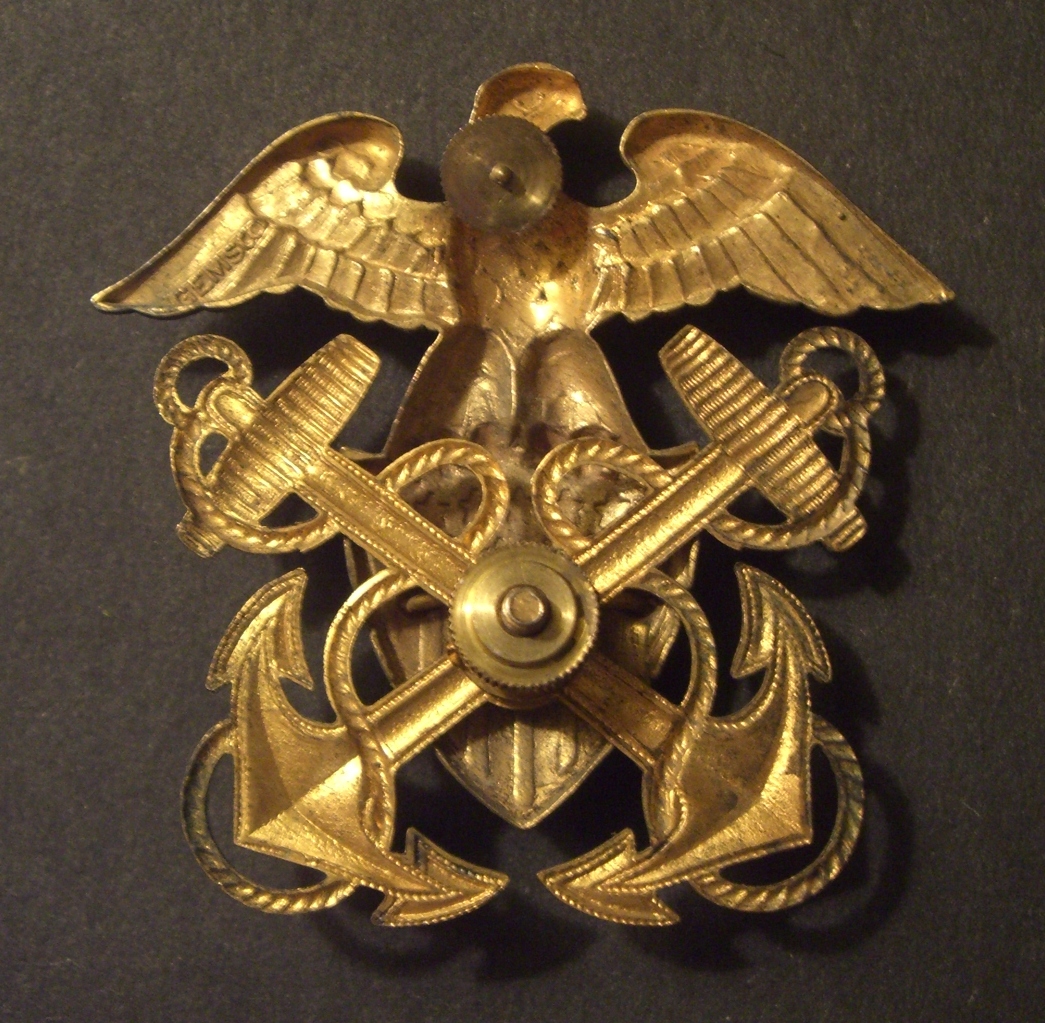
USATC-WD, Hat badge, reverse.
U.S. Army Transportation Corps - Water Division, officer, reverse


USATC-WD, Hat badge, reverse detail.
U.S. Army Transportation Corps - Water Division, officer, reverse


USATC-WD, Hat badge, obverse.

Plain shield with no enamel variation.


USATC-WD, Hat badge, obverse detail.


USATC-WD, Hat badge, reverse.


USATC-WD, Hat badge, obverse.

Plain shield with no enamel variation.

This specific hat badge is on display at the U.S. Merchant Marine Academy museum. It is in a shadowbox with an array of other hat badges worn by U.S. Merchant Marine Academy graduates. Among the other devices shown are U.S. Maritime Service commissioned and warrant officer, U.S. Army Corps of Engineers Floating Plant personnel, and Grace Lines. This badge appears to be a Pasquale badge, bringing to mind that these devices were crafted with expedience at the end of the Second World War. I suspect more care in regard to their detail came about in post-war years.


USATC-WD, Fake Hat badge, obverse.

This is a fake hat badge. During the Second World War, it appears that only Meyer and Gemsco eagles were used, with Vanguard-designed eagles being kept out of the fray. Perhaps maybe a Korean War-era Vanguard eagle such as this may have been defaced to create a TC-WD device; at least one is known to exist in the collection of Dave Collar. One means to determine a fake is to remove the TC device (if affixed with prongs) and look for an IOH (Institute of Heraldry) mark on the reverse. An easier determiner would be to look for the IOH number. For example, V-12 was used by Vanguard Industries beginning in 1965, with V-12-N after 1974 to denote a "Navy Approved" device. The TC-WD was long dissolved by this time.


Collar Brass

USATC-WD, Junior 3rd Officer collar brass

Despite the fact that the USATC-WD was a military organization, it was comprised of civilians, and as such they held traditional marine positions and titles. As follows is relative Army Rank and Marine title by department:

Deck
Colonel ... Master
Lt. Col ... Chief Officer
Major ... 1st Officer
Captain ... 2nd Officer
1st Lt ... 3rd Officer
2nd Lt ... Jr 3rd Officer

Engine
Colonel ... Chief Engineer
Lt. Col ... Staff Engineer
Major ... 1st Asst Engineer
Captain ... 2nd Asst Engineer
1st Lt ... 3rd Asst Engineer
2nd Lt ... Jr 3rd Asst Engineer

Steward
Major ... Chief Steward
Captain ... 2nd Steward
1st Lt ... 3rd Steward

Agent
Major ... Ship Transportation Agent
1st Lt ... Ship Transportation Clerk
2nd Lt ... Asst Ship Transportation Clerk


USATC-WD, 3rd Officer collar brass
...


USATC-WD, Chief Officer collar brass
...


USATC-WD, Master collar brass


Shoulder Boards


USATC-WD, Junior Officer shoulder boards

I would tentatively say that this set of shoulder boards would belong to a 3rd Officer; even though post-war regulations do not have such a board in the rank tables. Once again, for expediency's sake, it is highly probable that the ½-stripe board was not available (these were not commonly manufactured items), and the closest corresponding board to a USATC-WD 3rd Officer in the other marine services would have been Lieutenant (Junior Grade); hence the incongruous Lt (jg.) board.

Do note also that the boards have an applied U.S. Army Transportation Corps device as opposed to a woven device. The buttons are of late war U.S. Maritime Service vintage.

Rank stripes on cuffs and shoulder boards somewhat followed the relative rank structure found in the other sea services.

Deck
Master ... 4 stripes
Chief Officer ... 3½
1st Officer ... 3
2nd Officer ... 2
3rd Officer ... 1
Jr 3rd Officer ... ½

Engine
Chief Engineer ... 4
Staff Engineer ... 3½
1st Asst Engineer ... 3
2nd Asst Engineer ... 2
3rd Asst Engineer ... 1
Jr 3rd Asst Engineer ... ½

Steward
Chief Steward ... 3
2nd Steward ... 2
3rd Steward ... 1

Agent
Ship Transportation Agent ... 3
Ship Transportation Clerk ... 1
Asst Ship Transportation Clerk ... ½


USATC-WD, 3rd Officer shoulder boards


Note the applied cuff device to the board. This device was used in place of the U.S. Navy officer and staff corps devices, specifying USATC-WD officer status; many of the marine services adopted some variation of U.S. Navy officer and enlisted uniforms, merely substituting buttons or devices for USN ones. Interestingly, the USATC-WD did not have its own specific button made; instead, USN and "Merchant Marine" buttons were used.


Cuff Device


USATC-WD, Officer cuff device


Saturday, February 12, 2011

U.S. Army Transportation Corps, Water Division ship's officer

U.S. Army Transportation Corps - Water Division, officer
U.S. Army Transportation Corps, Water Division hat badge
Three piece construction.
Stamped brass with gold wash and applied red paint on shield.
Gemsco (NY) hallmark.
Circa Second World War era.


At the mid-point of the Second World War, and as the U.S. military establishment turned greater attention and allocated more resources toward the task of fighting the Japanese Empire, the U.S. Army streamlined its marine operations. The three disparate services which comprised the Army's water-borne forces came under the jurisdiction of the Transportation Corps. No longer was there an Army Transport (ocean going), Inter Island (Phillipine Island transports) nor Harbor Boat (intercoastal) Service; rather the all-inclusive Water Division.  The insignia and uniforms of the previous services were cast aside in 1944, and division took a distinctly Navy look.

This hat badge is one of two designs worn by licensed ship's officers.

References
Dave Collar. "Insignia of the Army Transportation Service in World War II." ASMIC: The Trading Post October-December 1994: 29-43.

William K. Emerson.  "Section XIII. The Army's Navy: Chapter Thirty-Six.  Army Transport Service and Harbor Boat Service." Encyclopedia of United States Army Insignia and Uniforms. Norman, Oklahoma:  University of Oklahoma Press, 1996. 331-352.

Steve Soto and Cynthia Soto.  "A collector's guide to the History, Uniforms and Memorabilia of the U.S. Merchant Marine and Army Transport Service during World War II." Privately Printed, 1996 (revised 2008).


USATC-WD, Hat badge, obverse.

U.S. Army Transportation Corps - Water Division, officer

Published regulations from August 1945 call for a red shield; however, for expediency's sake, many examples of this hat badge lack the red shield.  There are several variations on the theme:

Shield with no color.
Shield with red paint.
Shield with red enamel over all (obscuring the stars and stripes underneath).
Shield with red enamel on alternating stripes.

The reason behind calling for a red shield can only be guessed at.


USATC-WD, Hat badge, obverse, detail.

U.S. Army Transportation Corps - Water Division, officer, obverse detail

Changes to Army Transport and Harbor Boat Service uniforms and insignia was an evolving process, reflecting not only organizational but logistics processes within the services, but also the U.S. Army.

For close to a half-century the ATS maintained its own culture, traditions and fashion, closely mirroring that of the Merchant Marine and distinct from that of the U.S. Army.  As was common, young graduates of the various maritime schools and old salts alike would sign on with the ATS for a period of time, return to industry, and then go back to government service.  Service aboard ATS ships was akin to work on commercial ships manned by Merchant Mariners.  As a result, they both groups spoke the same jargon, shared the same age-old rituals and wore fairly similar uniforms of the trade.

After the end of the First World War, nautical garb in the United States followed the smart trends set in Europe, and those of Great Britain in particular - albeit with an American interpretation.  Gone were the old chokers and pillbox hats; in their place were rolled collar coats, Windsor-knot ties and combination hats. In the staterooms of the larger ships, licensed officers wore sleeve lace; on deck and in the wheelhouse, their hats had handsome and beautifully embroidered hat badges in silk floss and bullion thread. As shoulder boards with branch colors became the rage in Europe, they too were adopted by the Merchant Marine, and by extension the ATS. Thus, uniforms aboard ship were familiar to others in the same trade the world over.

As the Second World War wore on, the United States garment industry was taxed to the limits of production. To increase production, many uniforms were standardized and organizations within the Armed and Government Services tended to take on similar (if not the same) insignia. The ATS was not immune to these changes. Within the Army's water-borne services, the once distinct look to ATS uniforms changed as fabrics disappeared and the influx of mariners increased. Its ranks were augmented by the best and brightest graduates from U.S. Maritime Service schools, who brought their training uniforms along with them; ever thrifty and in an effort to build division-wide esprit de corps and professional appearance (read: military), Army regulations adapted the contemporary stock of uniforms and insignia. For licensed officers, the striking ATS hat badge was replaced with the Navy-style device as seen above; regulations called for red shield with a Transportation Corps device atop it. Shoulder boards were replaced with U.S. Navy-style boards with TC devices as opposed to a star. And, the service - now division - retained the distinct U.S. Army tradition of having insignia on coat lapels. The mariners were officially permitted to wear khaki uniforms - like their counterparts in the Maritime Service and U.S. Navy - bringing about a small constellation of insignia and devices.

The illustrated hat badge was worn primarily by ship's officers (licensed mates and engineers) serving at the Army schools in Louisiana and Florida, and on ships plying the Pacific. It was worn for a couple of years, and was quite unpopular as insignia go.

Many mariners held-out changing their uniforms and adopting the new insignia; but, with the transfer of the division to the newly-formed and Navy-controlled Military Sea Transportation Service, it was follow regulations or leave.

In the future I will post more images of USATC-WD insignia and its successor service, the MSTS; it provides an interesting windows on the convergence of nautical insignia trends at the close of the Second World War and into the Cold War.


USATC-WD, Hat badge, reverse.

Saturday, September 4, 2010

References for the Collector

U.S. Maritime Service Commissioned and Warrant Officer hat
Winter hat; navy blue wool with wicker frame, ½-in. wide. gold bullion chinstrap and two 22½-ligne gilt cap screws.  (note: if strap is ¼-in., hat would be that of a warrant officer).

Circa Second World War.


It is one thing to collect, and another to actually know what one is collecting. In a previous post, I detailed some known fakes and fantasies, and mentioned a few print sources for the collector. As follows is a reference bibliography; I will keep running updates as articles and works of interest appear - some are followed by a link to a downloadable pdf.

References:
Rudy Basurto. "Insignia of America's Little Known Seafarers, 2nd Ed." Privately Printed, nd.  pdf here.

Rudy Basurto. "Insignia of America's Little Known Seafarers, 3rd Ed. (edited and revised by Steve Soto and Cynthia Soto)."  Privately Printed, 2008.  pdf here.

Herbert Hillary "Sarge" Booker, 2nd. "Crow's Nest #1 (Summer 1992)." pdf here.

Herbert Hillary "Sarge" Booker, 2nd. "Crow's Nest #2 (Autumn 1992)." pdf here.

Herbert Hillary "Sarge" Booker, 2nd. "Crow's Nest #3 (Winter 1992)." pdf here.

Herbert Hillary "Sarge" Booker, 2nd. "Crow's Nest #4 (New Year's Special Issue - 1993)." pdf here.

Herbert Hillary "Sarge" Booker, 2nd. "Crow's Nest #5 (Summer 1993)." pdf here.

Herbert Hillary "Sarge" Booker, 2nd. "Crow's Nest #6 (Mid-Summer 1993)." pdf here.

Herbert Hillary "Sarge" Booker, 2nd. "Crow's Nest #7 (Autumn 1993)." pdf here.

Herbert Hillary "Sarge" Booker, 2nd. "Crow's Nest #8 (Special 1993 Encyclopedia Edition)." pdf here.

Herbert Hillary "Sarge" Booker, 2nd. "Crow's Nest #9 (Fall 1993)." pdf here.

Herbert Hillary "Sarge" Booker, 2nd. "Crow's Nest #10 (1994 New Year's Special)." pdf here.

Herbert Hillary "Sarge" Booker, 2nd. "Crow's Nest #11 (Spring 1994)." pdf here.

Herbert Hillary "Sarge" Booker, 2nd. "Crow's Nest #11 (Spring 1994 - The Issue That Never Was)." pdf here.

Herbert Hillary "Sarge" Booker, 2nd. "Crow's Nest #12 (Summer 1994)." pdf here.

Herbert Hillary "Sarge" Booker, 2nd. "Crow's Nest #13 (Fall 1994)." pdf here.

Herbert Hillary "Sarge" Booker, 2nd. "Specialty and Distinguishing Marks: U.S. Coast Guard, U.S. Maritime Service, U.S. Navy, and U.S. Public Health Service, 3rd Revision."  Privately Printed, 1996.  pdf here.

Dave Collar. "Insignia of the Army Transportation Service in World War II." ASMIC: The Trading Post October-December 1994: 29-43.

Dave Collar.  "Insignia of the United States Maritime Service, World War II." ASMIC: The Trading Post April-June 1995.

Dave Collar.  "Insignia of the United States Shipping Board." ASMIC: The Trading Post  October-December 1996.

William K. Emerson.  "Section XIII. The Army's Navy: Chapter Thirty-Six.  Army Transport Service and Harbor Boat Service." Encyclopedia of United States Army Insignia and Uniforms. Norman, Oklahoma:  University of Oklahoma Press, 1996. 331-352.
Steve Soto and Cynthia Soto.  "A collector's guide to the History, Uniforms and Memorabilia of the U.S. Merchant Marine and Army Transport Service during World War II." Privately Printed, 1996 (revised 2008).

Joseph J. Tonelli.  Visor hats of the United States Armed Forces: 1930-1950.  Atglen, Pennsylvania:  Schiffer Publicartions, 2003.

Monday, August 23, 2010

Fakes and Fantasies

For a collector of period items there is nothing more vexing than a fake or forgery offered as an original, vintage item. The higher the rarity, the greater the amount of fakes circulate.  Unfortunately, in the field of nautical insignia and hat badges in particular, there is a cottage industry of unscrupulous vendors offering fakes and thus inserting into an already small field a score of spurious items. Some collectors unwittingly scoop up these fakes, to the financial gain of the faker and detriment of the hobby.

An issue with maritime industry and U.S. Merchant Marine hat badges is that published references are few and far between for the interested student and serious collector. It is often difficult to determine what is truly a period or piece, given the paucity of information and relative sophistication of fakers.  Coupled with the aforementioned, insignia items are often altered, defaced or invented by bored mariners, thus provenance and determination of "genuineness" is at times problematic. Fortunately there exists a small number of references devoted to the subject: a self-published book by Rudy Basurto acts as a general catalog and starting point for anyone interested in the subject - it is not an academic treatment of insignia, rather is more a collection of images and pithy descriptions and some of the insignia depicted exist only in long-lost regulations; a smattering of articles published in the ASMIC Trading Post by Dave Collar and Bill Emerson have depth to their descriptions and illustrate insignia quite well; a more specialized treatment of U.S. Maritime Service and Army Transport Service (in its various guises) is found in a self-published work by Steve Soto and Cynthia Soto; ATS-only topics are treated by Bill Emerson in his encyclopedia survey of U.S. Army Insignia; perusing Herbert Hillary "Sarge" Booker's newsletter "Crow's Nest" details some of Basurto's material and offers variations of maritime insignia; Joseph Tonelli, in his Visor hats of the United States Armed Forces presents some handsome examples of many common and not-so-common head wear of the sea services, with the Maritime Service and Merchant Marine included.  In a future post I will provide a list of the majority of published and "self-published" works on the topic.  Readily accessible, Collar and Emerson are indispensable; take care in looking at  Basurto's "book"; it is a good starting point, however many of the hazy depictions of insignia have been picked up by forgers.

As follows is a gallery of fakes, plain and simple, along with a discussion of each. A great many of these items were manufactured in the 1980s and began re-surfacing in the early 2000s to the present day.


ATS Chief Petty Officer
This device comes up in online auctions from time-to-time with examples in bronze. The dead give-away for this badge is the "hand applied" rope. The wire is loose, and the reverse solder is blotchy. Fakes of this badge often have the NS Meyer hallmarks - this is due to the fact that the dies were sold at auction in the 1990s when the NS Meyer plant closed - every quarter about 3-4 of these badges find their way to sale.


USMS Chief Petty Officer
The applied anchor is a dead giveaway. No USMS CPO devices were ever manufactured that have said application.


US Coast & Geodetic Survey Officer
This is a fun badge. The eagle is actually a MSTS eagle with a USCG shield and USN anchors. US C&GS hat badges from the time of the Second World War are exclusively woven. Only postwar did metal hat badges come to be manufactured; and with those matching NOAA examples from the present day.


US Coast & Geodetic Survey Senior Chief Petty Officer
This badge is problematic in several ways. It was not until 1968 that the US Navy Uniform Board approved a Master and Senior Chief Petty Officer cap insignia - similar to their collar devices, with one or two silver stars superimposed on the anchor, inverted and centered on the stock. The US Coast Guard soon followed the US Navy's lead in 1970, as did the US C&GS. The US C&GS never had Chief Petty Officers, per say, as all unlicensed mariners aboard ship were un-uniformed Federal, civil-service employees. Proposed insignia tables were published in 1965 without examples being produced. With the transfer of the agency to the Environmental Science Services Administration, all non-commissioned officer positions were removed and finally ceased to be with the 1970 reorganization into the National Oceanic and Atmospheric Administration.
Further complicating matters for this particular hat badge is the fact that the star is not of the type used by any of the licensed manufacturers of US Military establishment insignia, and and the anchor itself is that of a US Navy ROTC/Anapolis midshipman. The only US CG&S true device is the triangle within the circle.


USMS Supply Officer
This purports to be a hat badge, however, it may be an attempt to create a collar badge which existed only in regulation form.


US Navy Commissioned Officer
This is quite frankly a fantasy. An actual US Navy Commissioned Officer hat badge of the "pre-1940s" type has been detailed previously. This badge may also be seen in a similar configuration as a WSA badge with bronze anchors. Caveat emptor.


USMS Gunner
No such badge was ever produced or existed. Unofficial ATS examples are without supporting strut and are wreaths with a pin-on center device; the same is true for MSTS hat badges.


ATS Radioman
This is sometimes advertised as either an ATS Electrician or Radioman. See above.


ATS Craftsman
See above.


ATS Clerk
See above.


US Army Harbor Boat Service - Tug Boat Service
This is a fantasy.


Harbor Boat Service Officer
This is a fantasy, and a fun one, at that. Oftentimes fantasies will purport to be a variation by the mere application of a small device on the shield of a US Navy Commissioned Officer's hat badge. Given that not only is the hat badge incorrect for the period (pre-1940), the US Army Quartermaster's device is also incorrect for the same.